


When your child timidly asks, "I'm bored, what can I do?", see it as a golden opportunity. Rather than immediately pulling out a list of activities, invite them to explore their creativity and take initiative. It's a unique chance to cultivate their independence, build their self-confidence, and strengthen your bond.
Turning boredom into a growth opportunity
Boredom isn't a problem to be solved; it's a springboard for developing essential skills. For children aged 6 to 12 , this mental pause is often the prelude to a flood of new ideas. Your role isn't that of a constant facilitator, but rather a caring guide who helps your child tap into their own inner resources.
This is the perfect time to teach him how to manage frustration and find solutions on his own. A study from the University of East Anglia highlights that boredom can act as a catalyst for the imagination , encouraging everyone to come up with new ideas.
The key is to propose, not to impose.
Instead of giving instructions like "Go draw," rephrase your suggestions to involve them: "If you could create a magical adventure, what would it look like today?"
This subtle nuance gives him responsibility for his imagination while offering him a safe framework to explore it.
Boredom is the blank canvas on which imagination paints its most beautiful works. By guiding your child, you give them the brushes, but it is up to them to choose the colors and create their masterpiece.
Before diving into the details, here's a summary to help you act without delay.
Anti-boredom strategies for an immediate response
An overview of three areas of action to transform your child's boredom into an opportunity for personal development.
| Strategy | Main objective | A concrete example to test |
|---|---|---|
| Guided independent activities | Boosting confidence and creativity | Provide him with a "story box" containing various objects (string, pebbles, characters) so that he can invent a story. |
| Creative family rituals | Strengthening the bond and emotional well-being | Establish a "creative quarter hour" after school where everyone shares a drawing or an idea without judgment. |
| Long-term projects | Cultivating perseverance and pride | Start creating a family herbarium after a walk in nature, to be completed over the seasons. |
These initial approaches establish a framework that is both flexible and encouraging, centered on the child's growth.
In the rest of this guide, you will discover how to:
- Encourage the expression of emotions and ideas with tools like the My Book Story notebook.
- Establish simple family rituals that nurture emotional bonds.
- To offer guided projects that stimulate their curiosity and autonomy.
Decoding the real message behind boredom
When your child sighs, "I'm bored, I don't know what to do…", they are rarely simply expressing a lack of activities. For children aged 6-12 , boredom is a signal, an invitation to look at what's really going on inside them.
Sometimes, it's his brain that's craving a new challenge to thrive. Other times, it's a more subtle call for connection: he doesn't just want to do something, he wants to do it with you . Instead of reflexively responding, "Find yourself something to do!", let's take a moment to decode this hidden need.
Identify the hidden need
To help him, ask him open-ended questions that encourage him to explore his own feelings.
-
Instead of saying, "Do you want to draw?"
-
Try this instead: "How do you feel inside? More calm like a sleeping lake or agitated like a volcano about to erupt?"
-
Instead of saying, "Go play outside."
-
Try this approach: "If your imagination were a magic door, where would it take us right now?"
The goal isn't to fill the void of boredom at all costs, but to embrace it as fertile ground. It's in this apparent emptiness that creativity and self-knowledge have room to germinate. Rushing in with ready-made solutions risks stifling one's ability to find one's own answers.
This simple decision tree can help you and your child visualize possible paths to transform this moment of uncertainty into a constructive experience.
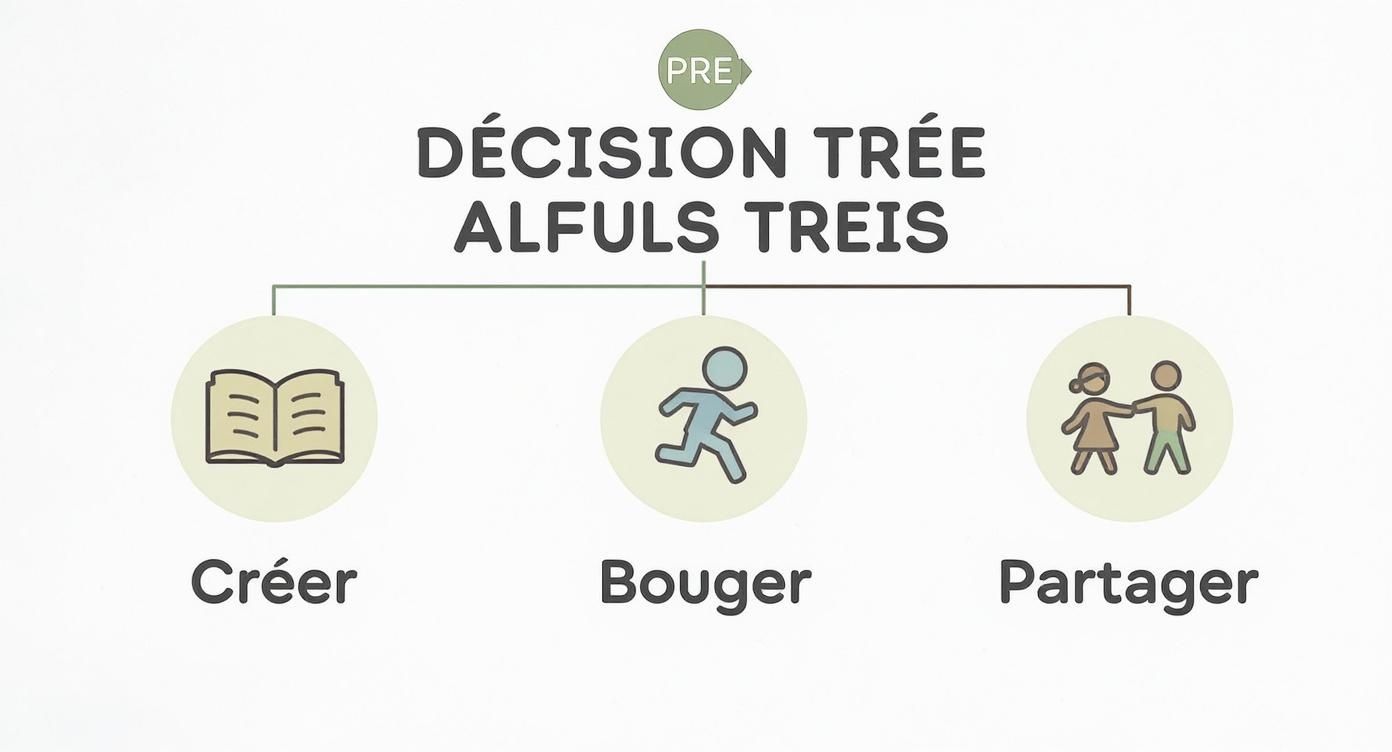
It's clear here that boredom isn't a dead end. It can lead in three fulfilling directions: creating , moving, or sharing . Each fulfills a fundamental need for their development. By presenting things this way, you help them become the captain of their own well-being.
Transforming a corner of the house into a creative workshop
To answer the famous "Mom, Dad, I'm bored," nothing beats a space that encourages spontaneous creativity. No need for a dedicated room; a small corner is enough for your child's imagination to flourish.
A desk near the window, a small table, or a rolling cart can become a veritable idea lab. The key is that the materials are visible and easily accessible , so they can take what they need without having to ask.
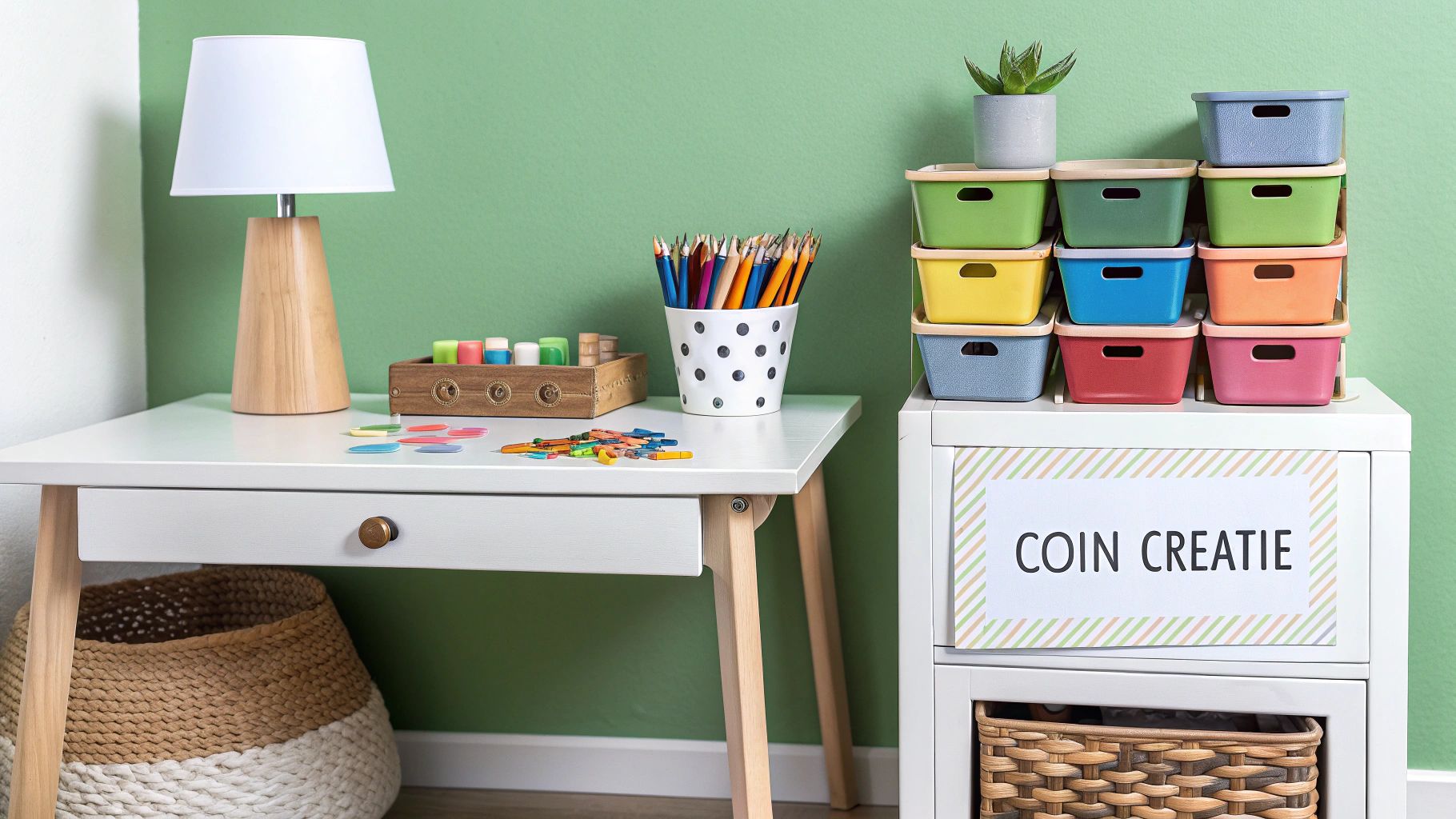
Making the space inspiring and practical
A well-designed creative space fosters autonomy and the desire to do things independently.
- Mobile trolley : Ideal for transporting felt-tip pens, paper, scissors and modeling clay from the living room to the bedroom.
- Inspiration wall : A corkboard or grid to hang drawings, inspiring photos or nature souvenirs.
- Treasure box : Encourage him to collect pebbles, leaves, ribbons, or scraps of fabric. These everyday objects are powerful storytelling triggers.
A well-organized creative workshop is not a source of disorder, but a driving force for autonomy. It is the place where boredom spontaneously transforms into a project, strengthening one's confidence in their ability to create.
By simplifying access to the material, you give him the keys to fill his empty moments on his own with vibrant ideas.
Using a journal to channel one's imagination
When faced with a child who is restless and incoherent, the My Book Story notebook is more than just a simple journal: it's a window into their inner world. A safe and private space where every thought, emotion, or idea, even the most outlandish, has the right to exist.
Your role is that of a guide who ignites the initial spark. A few suggestions are all it takes for stories and drawings to come to life.

Creative starting points to launch the adventure
Rather than leaving him facing a blank page, offer him playful prompts that stimulate his imagination and self-expression:
- Imagine that one of your toys could talk : what is the first thing it would tell you about its day?
- Draw a map of a secret world located at the bottom of the garden. What treasures are hidden there?
- If you had a superpower linked to an emotion (like joy or courage) , how would you use it to help a friend?
The goal is to transform the blank page into a playground where the child feels free to explore not only their ideas, but also their emotions, in complete safety.
Testimonials and feedback
Families share how the journal has become a soothing and creative ritual .
A mother's story:
"My son no longer asks me what to do. He takes his notebook and tells me: 'I'm busy, I have to write down what my character is feeling!' It has become his secret garden."
By accompanying them at the beginning, you help them move from "I'm bored" to "What story can I invent today?". This is a huge step towards greater emotional autonomy and creative confidence .
Rediscovering the joy of playing together
Sometimes, the best answer to "I'm bored, what should we do?" isn't a solitary activity, but a shared adventure. Family playtime is a powerful antidote to boredom because it fulfills a fundamental need for connection and belonging.
This trend towards indoor leisure activities, which encourage shared experiences, is booming. The sector is growing by approximately 6% annually, driven by concepts that emphasize interaction. For those curious, current trends in the leisure industry confirm this.
The good news? No need to go out or spend money to recreate this magic at home.
Your living room, your new adventure playground
The goal is not just to fill the time, but to create a family ritual, a memorable keepsake that will strengthen your bonds.
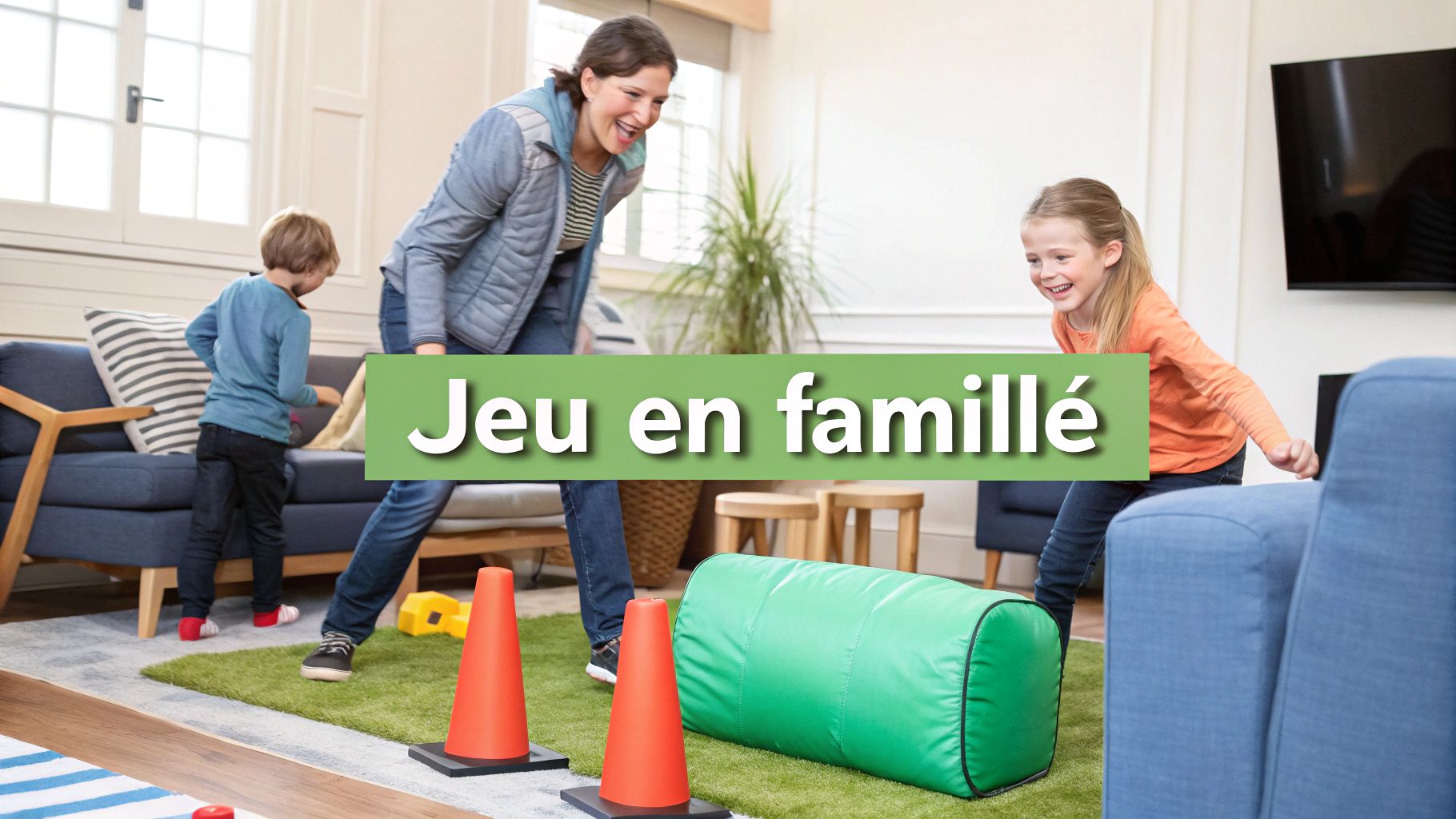
Some ideas for transforming your home into a play space:
- The "teddy bear rescue" mission: Hide their favorite teddy bear and create a series of simple riddles based on family memories ("I am where Dad reads his bedtime story"). Each clue reinforces the sense of belonging.
- The Trust Course: Cushions become islands to cross, chairs become tunnels. The challenge? To guide each other in turn, blindfolded, using only voice. An excellent exercise in communication and mutual trust.
- The "Emotion Cakes" Workshop: Suggest baking a cake that represents an emotion. A "joy" cake might be colorful and full of fruit, while an "anger" cake could be made with very dark chocolate and sprinkles of chili pepper (mild!). It's a fun way to talk about feelings.
These moments of shared play are much more than just entertainment. They nurture your child's need for connection and show them that family bonds are the most powerful remedy against feelings of emptiness.
By transforming her complaint into an invitation to connect with you, you offer her a precious gift for her life: the certainty that love and sharing are inexhaustible sources of joy.
How to help your child cope with boredom alone
The ultimate goal is to equip him to become self-reliant in the face of boredom. Your role is not to be his "activity provider," but to teach him to find within himself the resources to transform these moments of emptiness into opportunities.
The secret lies in communication that encourages him to take his own initiative. Instead of offering ready-made solutions, ask open-ended questions that stimulate his thinking. A simple "What does your imagination want right now?" is much more powerful than "What if you built a castle?"
This approach values the effort and the creative process , not the final result. Celebrate his attempts, even if they don't succeed. Every little idea he comes up with on his own is a victory that builds his self-confidence and his ability to overcome boredom.
Let your child take the reins, step by step
To support him without doing it for him, here is a gradual approach that fosters his autonomy:
- 1. Validate their emotion: Always start by acknowledging what they are feeling. "I can see you're bored, it's not a pleasant feeling. I understand." This shows them that their feeling is legitimate.
- 2. Empower them: Ask a question that invites them to take action. "What is the smallest thing you could do to change this feeling a little?" or "If you had a magic wand, what would you make appear?"
- 3. Celebrate the initiative: Praise him for the idea, whatever it may be. "It's a great idea to want to build a cabin! What do you want to start with?" This reinforces his sense of competence.
This approach is all the more relevant given the rise in family spending on leisure activities. In France, it jumped by 40% between 2019 and 2024. To learn more, consult this analysis on the evolution of the indoor leisure market on Modelesdebusinessplan.com .
By guiding your child towards their own solutions, you are doing much more than filling a moment of emptiness. You are giving them an essential life skill: the ability to find within themselves the resources to be happy and creative.
Questions that all parents ask themselves
Supporting your child through boredom is a process. It's normal to have doubts. Here are answers to frequently asked questions to help you navigate these moments with confidence.
What to do when he refuses everything outright?
This systematic refusal often masks another need: to be heard in their frustration, to assert their opinion, or simply to rest. Instead of insisting, validate their emotion: "I see that nothing appeals to you right now. It can be frustrating to feel like this."
Next, offer some "quiet time" without screens. Let him lie down, look out the window, do nothing. It's often in this silence that his own solution finally emerges. Providing this space is a precious gift.
What if he doesn't like to draw or write?
Creativity takes a thousand forms! If your child needs to move, build, or experiment, explore other avenues:
- The construction corner: LEGO, Kapla, but also old cardboard boxes and adhesive tape to build a cabin or a spaceship.
- The sound workshop: Create instruments with tin cans, rice, and rubber bands. Invent your family's anthem together!
- Improvisational theatre: Issue a challenge: "Mime a cat's day as it discovers the moon for the first time." Laughter is a great remedy for boredom.
At what point should I intervene (and when should I leave him alone)?
Think of yourself as a gardener. Your role is to prepare the soil (the creative environment), plant the seed (the initial idea), and then step back to let the plant grow . Intervene only if he asks for your help or if he's blocked by too much frustration. It's through this autonomy that he develops his perseverance and confidence in his abilities.
How do you manage boredom when there are several of them?
Boredom among siblings can quickly turn into conflict... or become an incredible opportunity for cooperation! Propose a joint project where each child has a role defined according to their strengths.
- Example: Create a play. One person writes the script, another creates the costumes from old clothes, and a third takes care of the set design. The shared goal transforms potential rivalry into a joyful collaboration.
Give your child a companion to transform every moment of boredom into a creative adventure. The My Book Story notebook is designed to guide 6-12 year olds in exploring their imagination and building their self-confidence.
Discover the My Book Story notebook and encourage their independence today .