


What if we stopped thinking that books on self-growth are reserved for adults? In reality, they are an incredible resource to support our children. For a child aged 6 to 12 , these readings are much more than simple stories: they are fun tools to boost confidence , learn to put words to emotions and cultivate creativity. Enough to lay the first bricks of a serene and fulfilled future.
Why start personal development from childhood?
Personal development for a child isn't a race for performance. It's more like building a super toolbox for their emotions and future life. Think of it like building a house: self-confidence, empathy, and resilience are the foundations. The stronger they are, the more smoothly your child will be able to navigate life's challenges.
As a parent, you may wonder how to approach such profound topics. The answer is simple: through play, discussion, and shared reading. Your role is that of a caring guide, transforming somewhat abstract concepts into an adventure to be experienced together, thus strengthening family bonds.
Turning challenges into adventures
Rather than lecturing, a book can spark a conversation without seeming to. A story about a character overcoming shyness becomes a gateway to talking about courage. A story about friendship opens a conversation about what it means to be a good friend.
The benefits for your child's development are truly concrete:
- Emotional Intelligence : Children learn to recognize their feelings and understand others. This is the basis of any healthy relationship.
- Self-confidence : By identifying with successful heroes, he becomes aware of his own qualities.
- Boosted creativity : Stories inspire him to imagine his own solutions when faced with an obstacle.
The goal of personal development for a child is to give them solid roots to grow well and wings to soar. The idea isn't to make them perfect, but to help them become adults who are comfortable in their own skin, aware, and resilient.
In France, the subject is still sometimes a bit sensitive. The fact that nearly 44% of French employees say they are experiencing psychological distress clearly shows the urgent need to address mental well-being from a young age. You can learn more about the taboo surrounding personal development in France to understand why it's so important to start early. By approaching these topics in a fun and loving environment, you're giving your child a gift that will serve them throughout their life.
How to Choose a Good Book for Your Child
Choosing the right self-help book for your child can seem like a daunting task. However, it's much simpler than it seems. The idea isn't to impose a lesson on them, but to find a story that speaks to them, an adventure to share that will open the door to rich and caring conversations.
The secret? Characters they can identify with. A good hero isn't perfect—far from it. They have doubts, they make mistakes, and, above all, they learn to get back up. It's by seeing them overcome their own challenges that your child will realize that they, too, have what it takes to overcome their own.
Identify key themes and messages
A book that helps a child grow addresses universal themes with simplicity and optimism. The tone should always be positive and accessible, encouraging without ever judging. Look for stories that highlight essential skills for 6- to 12-year-olds :
- Managing emotions: How does the character manage their anger or sadness? Does the book provide constructive suggestions?
- Empathy and Friendship: Does the story show the importance of understanding others and building strong bonds?
- Discovering his strengths: Does the hero learn to recognize his talents, even if they are different from those of others?
- Resilience in the Face of Failure: Does the book downplay mistakes? Does it show that we always have the right to try again?
These elements are fundamental to making reading a real tool for self-confidence.
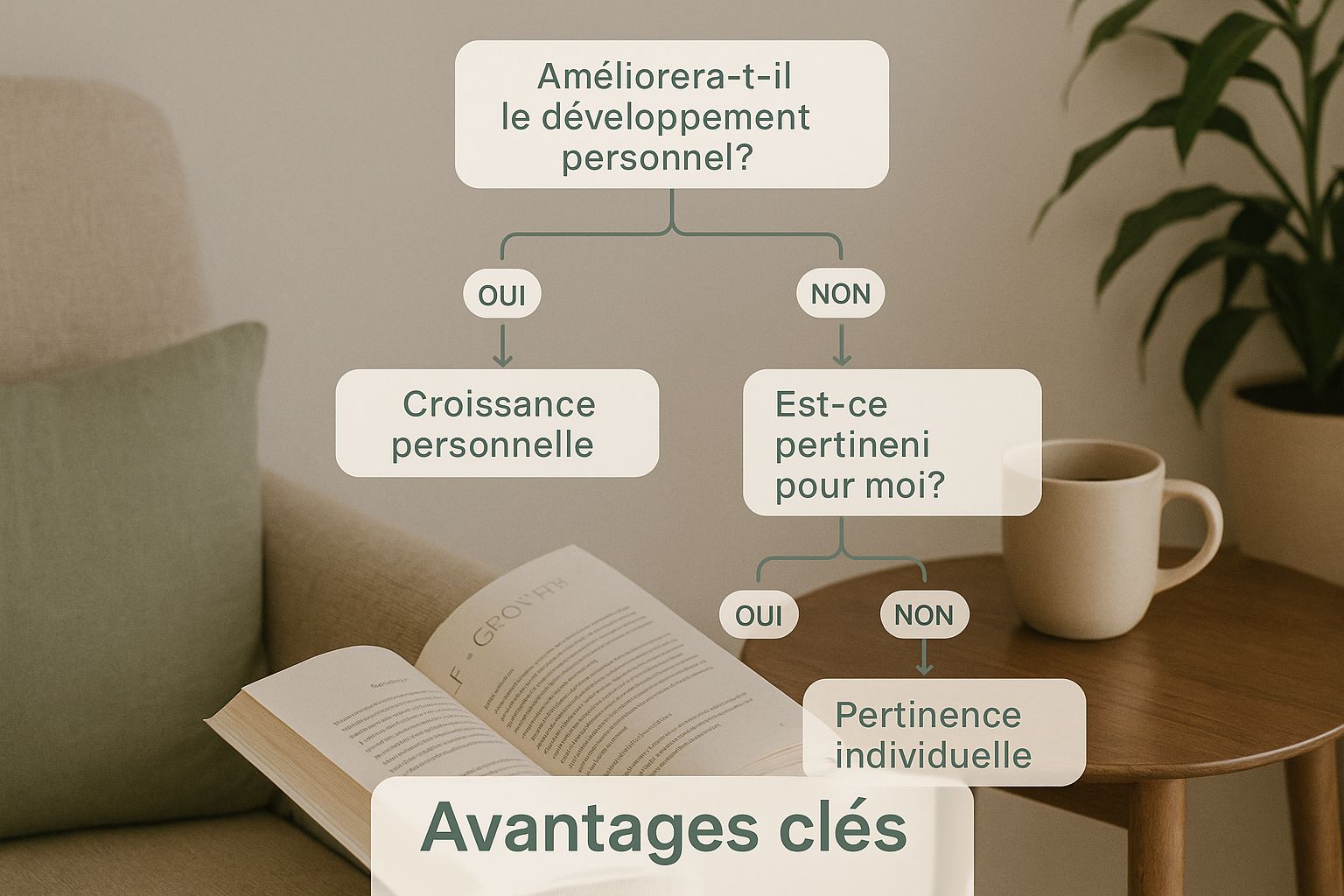
By focusing on these aspects, a simple book becomes a powerful lever to strengthen your child's emotional balance and well-being.
A practical tool to help you make the right choice
To help you quickly evaluate a book, whether in a bookstore or online, here's a small table. It summarizes some simple but effective criteria for you, parents. Remember, for example, that illustrations aren't just there for show! They must truly support the message and help the child decode the characters' emotions.
Criteria for choosing the right book for your child
This chart will help you quickly assess whether a personal development book is appropriate for your child's age and needs.
| Criterion to be evaluated | Positive signs (what to look for) | Warning signs (what to avoid) |
|---|---|---|
| The main character | An imperfect, endearing hero who makes mistakes and learns from them. | A perfect character, moralizing or who finds solutions too easily. |
| The message of the story | Positive and encouraging, focused on the child's solutions and strengths. | A guilt-inducing tone, which points out faults or imposes a single "right" way of doing things. |
| The language used | Simple, accessible, and age-appropriate. Rich yet understandable vocabulary. | Complex jargon, abstract terms or language that is too childish and doesn't take it seriously. |
| The illustrations | Expressive, they support the story, clarify emotions and invite discussion. | Purely decorative, disconnected from the emotion of the text, or too simplistic. |
| The end of the story | An open ending that invites reflection and dialogue, without imposing a single moral. | A closed conclusion with a ready-made "lesson" that leaves no room for interpretation. |
Keep this short guide in mind as you research. It will give you clear guidelines for choosing books that will have a lasting positive impact, transforming every reading moment into a wonderful opportunity for family connection.
Themes that really build self-confidence
Have you chosen a book? Perfect, that's a great starting point. Now, let's see what's inside . For a book to become a true development tool for your child, it must address themes that speak to them, that echo their own challenges and small victories.
Knowing these themes well will certainly help you sort through them. But more importantly, it will give you the keys to transform reading into a real moment of exchange. Each story then becomes an opportunity to discuss, strengthen your bonds, and anchor the book's lessons in everyday life.

Making mistakes is how you learn!
One of the most valuable lessons you can teach a child is that making mistakes is part of the fun . In fact, it's a necessary part of learning. Books that feature characters who mess up, who fall down but then get back up and try again are real gems. They teach resilience gently, without preaching.
Tip for parents: Establish a family ritual after reading on this topic. Every night, at dinner or bedtime, everyone shares their "nice mistake" from the day. This helps take the drama out of failure and shows that everyone, even mom and dad, continues to learn throughout their lives.
Finding what makes us unique
Comparisons often begin to emerge between the ages of 6 and 12. Books that celebrate the diversity of gifts and personalities are therefore crucial at this age. We might discover a hero who isn't the best at soccer, but who has a knack for inventing imaginary worlds or comforting a friend who is grieving.
The idea is not to make them believe that they are the best at everything, but to help them see and appreciate their own strengths, the ones that make them so special.
Tip for parents: Create a "talent box" at home. Everyone can add little notes to share a quality they appreciated in another family member today. It's a simple and practical way to feel valued and boost everyone's confidence.
Welcome all your emotions, even the strongest ones
Rising anger, tight sadness, paralyzing fear... These emotions can be like storms for a child. Books that put them into words and pictures are a valuable help. They help children understand what's going on inside and accept these feelings without judgment. A character who teaches them how to breathe to calm down gives your child a technique they can try themselves next time.
Here are some ideas for activities to do as a family, inspired by your reading:
- After a story about anger: Draw an "anger volcano" together. Discuss what makes it boil and what can be done to calm it down before it erupts.
- After a book on courage: Launch the "courage mission." Each week, we share a small moment when we were courageous, even if it was for a very small thing.
- After a story about sadness: Make a "cuddle box" filled with vouchers for tender moments, to use without moderation when needed.
By building on these key themes, each book you read together will become more than just a story. It will be the beginning of a conversation, a game, a precious memory that will build your child's confidence, brick by brick.
Create a caring family reading ritual
Having the right self-growth books on hand is great. But the real magic happens when you transform reading into a true family ritual, a warm and comforting moment. The important thing isn't to devour dozens of books, but to savor the quality of these shared moments.
This appointment then becomes a kind of safety bubble. It's a space where your child will feel confident enough to say anything, without fear of being judged. The goal is for this moment to become a routine to look forward to, not just another box to check off on the schedule.
Create an inviting reading corner
No need to push the walls! A small, well-designed corner is more than enough to create an atmosphere that invites confidence. Choose a quiet, cozy place where you can be sure not to be disturbed.
Some simple ideas for your storytelling nest:
- Soft cushions or a large pouf so you can curl up comfortably.
- A soft light , like a small bedside lamp, for a subdued and soothing atmosphere.
- A small shelf or basket within easy reach with a few books, so your child can also choose.
By creating this space, you send him a strong message: "Here, we stop time, we find ourselves and we imagine." It's a clear signal that helps him relax and open up.
Establish a routine without constraints
The key is consistency, but a flexible consistency. The idea is to create a positive expectation. This "reading time" can easily be done in the evening before bed, on weekends after breakfast, or even after homework to take a breather.
What really matters is that you're fully available during this time. No phone, no notifications, no distractions. Your child will immediately know the difference between a truly present parent and one in a hurry to get things over with. Trust me, 15 minutes of undivided attention is worth a thousand times more than an hour of rushed reading.
Using stories to open dialogue
Reading becomes a powerful tool when it serves as a starting point for discussion. After finishing the story, take the time to ask a few open-ended questions. Avoid closed-ended questions that only require a "yes" or "no" answer.
The goal isn't to check if they've followed the lesson, but to help them explore their own emotions by projecting themselves into those of the characters. It's a very gentle way to approach the small and large worries of everyday life.
Here are some ideas to start the conversation:
- "What do you think the character felt at that moment?"
- "Have you ever felt like this? Tell me about it."
- "If you had been in his place, what would you have done?"
- "What's your favorite part of the story? Why that one?"
Through these small exchanges, a simple story turns into a profound discussion about life, emotions, and values. You give your child the words to express what they feel and, above all, the certainty that their feelings are important and listened to.
The personal journal: another way to grow, more creative than books
Self-growth books are a great starting point for family discussions. But what happens after the book is closed? To help your child truly take ownership of the ideas they've discovered, there's a great alternative: journaling .
This isn't a homework book at all! It's much more than that. The journal becomes a space for completely free expression. Your child moves from the role of reader to that of author of their own story. This is where they can put their emotions into words, explore their dreams, and celebrate their small victories. The somewhat abstract concepts in books then become very real experiences—their own.
By writing or drawing a little each day, he learns about himself, stimulates his creativity, and builds his self-confidence. It's his secret garden, a safe place where he can put his thoughts down without being judged. It's simply the next step in bringing the lessons from his reading to life.
How to encourage your child to keep a journal?
The goal is definitely not to impose a new chore on him. You should present the newspaper as a game, a companion on an adventure. The key is to make it fun and pressure-free.
Here are some tips from parents to get you started smoothly:
- Find the perfect notebook: Let your child choose a notebook that catches their eye. Whether it's colorful, glittery, or features their favorite superhero, the important thing is that they make it their own.
- Create a small, enjoyable ritual: It doesn't have to take hours. Five or ten minutes a day is perfect. You can incorporate it into an existing routine, such as after snack time or just before bedtime stories.
- Guide him with simple questions: At first, he might need a little help. You can give him some fun ideas to inspire him.
A personal journal isn't a writing exercise. It's a space for freedom. The most important thing is to encourage expression, whether through drawing, collage, or just a few words.
The success of personal development is undeniable. In fact, in France, this section represents approximately 32% of the total book market , proof that we all need tools to feel better. Journaling fits right into this trend by offering a concrete method for putting into practice the good ideas we read. To learn more, take a look at the importance of personal development in publishing , you will see how well this practice complements reading.
Some ideas to never run out of inspiration
Afraid of the blank page? Here are some concrete examples to offer your child to get started:
- Inner Weather: "What's the weather like in your heart today? Bright sunshine, clouds, or a little rain?"
- The Happy Moments Box: “Draw or write three little things that made you smile today.”
- The Superpower Detector: “Tell me about a time when you used one of your talents, such as kindness, courage, or imagination.”
By turning reading into an active experience, journaling helps your child build confidence and understand themselves better, page after page.
Your role as a parent in this adventure
In this quest for fulfillment, your role is not that of a teacher, but rather that of a guide, an accomplice. The idea is not to sculpt a "perfect" child, but to give them the keys to building their own inner compass. A compass that will help them navigate storms and sunny days alike, with confidence and serenity.
Every book you read together, every conversation that follows a story, is a small seed you plant for their future well-being and the strengthening of your family bonds.
The key is to create a space of trust, a cocoon where he feels free to explore what he feels, without fear of being judged. By truly listening to him and sharing your own doubts and joys, you show him that growing up is a journey we take together, with its successes and missteps.
What if we started today?
Interest in these topics has never been stronger. The global personal development market is now worth more than $40 billion and continues to grow. In France, even though the book sector has its ups and downs, books on well-being retain a prominent place in bookstores. To delve deeper into the subject, you can take a look at the key figures for publishing in France .
What this craze tells us is simple: we're all looking for ways to feel better, young and old. So why wait?
Remember that every little helps. Simply picking up a first book together or opening a journal for the first time can be the start of a wonderful family adventure.
No need to wait for the perfect moment. It doesn't exist. Choose a story you like, sit back, and immerse yourself in it. It's in these simple moments that the most beautiful memories are created and solid self-confidence is built. You already have everything you need to be the best guide for your child.
We answer your questions about personal development books for children
Getting started with books on self-confidence or emotions for 6-12 year olds can raise a lot of questions. That's perfectly normal! We've gathered the answers here to help you see things more clearly and support your child in this exciting adventure.
At what age can you really start?
There is no ideal age set in stone, but let's say that the approach changes over time. From 3 or 4 years old , we can already lay the first bricks with very illustrated albums that put simple words and images on the big emotions: joy, anger, sadness...
Between the ages of 6 and 12 , we move up a gear. The themes become more refined. This is the perfect time to gently address self-confidence, managing small (and large) frustrations, empathy, or even discovering hidden talents through more structured stories.
My child isn't a great reader, what do I do?
Above all, no pressure! The idea is that reading remains a pleasure, never a chore. If your child is a bit reluctant to read classic books, don't panic, there are plenty of other equally interesting options:
- Audiobooks: A great alternative to fuel the imagination and develop listening skills, without the effort of deciphering.
- Comics: The mix of images and text often makes the story easier to follow and truly captivating.
- Let him take the wheel: Take him to a bookstore or library and let him choose. When you're in control of your own reading, it changes everything!
How do you know if a book really has a positive effect?
The impact of a book isn't always immediately visible; it's a long-term process. But there are some small signs that can't be ignored. You'll know a story has made its mark if your child:
Start using new words to express how he feels. For example, if he says "I feel frustrated" instead of just yelling that he's angry, that's a giant step! This is a sign that he's developing his emotional vocabulary.
He may also start talking about a character or situation in the book to explain something that happened to him. These little clicks show that the story is actually helping him better understand himself and navigate the world around him.
And if you're looking for a way to turn these readings into an even more personal and creative adventure, check out the My Book Story Journal. It's a great tool for your child to become the author of their own story. Discover the My Book Story Journal today.