


Let's be honest, choosing a book for your child is much more than just an activity. The best self-help books aren't just beautiful stories; they're veritable toolboxes to help your child grow with confidence, creativity, and a healthy dose of emotional intelligence. By integrating these books into your daily life, a simple moment of sharing transforms into an enriching discussion, a true springboard for their development.
Why read these books with your child?
In our fast-paced world, giving our children the tools to understand themselves and manage their emotions is undoubtedly one of the greatest gifts we can give them. Far from being dry manuals, these books are open doors to gently explore important topics. They act a bit like a mirror, where your child can recognize their own challenges through the adventures of a relatable character.
Instead of directly telling him "be brave," a story will show him concretely what courage means, by following a little hero who manages to overcome his fear of the dark. This is a much more effective approach, because it leads him to his own reflection, without imposing a lesson.
Making the connection between history and one's own life
This is where the magic truly happens: when we manage to build a bridge between what we read and our child's everyday life. Each story then becomes a wonderful opportunity to talk and strengthen your bond.
For example, after reading a book about anger, a simple question like, "Do you remember when the little dragon turned bright red with anger? Do you ever feel like that?" can make all the difference. You validate their emotion, you show them they're not alone in feeling this way. And that's the first step in helping them find their own strategies for calming down.
A book becomes a tool for personal development not only through its content, but also through the conversations it inspires between a parent and child. It is in this sharing that the seeds of self-confidence and resilience are planted.
Developing essential skills for tomorrow
Beyond managing emotions, these shared reading moments are a fantastic playground for developing essential life skills. It's a fun way to:
- Nurturing empathy: Putting yourself in the shoes of characters helps your child understand what others might be thinking or feeling.
- Stimulating creativity: A story that shows how to find original solutions to a problem encourages him, too, to think differently.
- Boosting self-confidence: Identifying with a hero who succeeds despite difficulties gives him proof that he, too, is capable of overcoming his own challenges.
In short, choosing the best personal development books for your child aged 6 to 12 isn't just about expanding their library. It's about offering them a safe space to explore their inner world, better understand others, and build, page by page, a solid foundation for their well-being.
How to choose the right book for your child
Every child is a little universe unto themselves, with their own joys, fears, and dreams. To find the best self-help books , the ones that will truly resonate with them, the first step is quite simple: observe them with curiosity and kindness. The idea isn't to look for "problems" to fix, but rather to understand what's happening inside them right now.
Is your child the type to keep to themselves on the playground? A story about the courage to make friends could be just the spark they need. Do they tend to explode like a volcano when frustration builds? A book that focuses on managing anger could give them some great tools.
Identify the needs behind the behaviors
Often, a behavior masks a deeper need. A child who fears failure doesn't need to be told to stop being afraid. Rather, they need stories that value effort and perseverance, far more than the final result. It is by making this connection that books become a true ally for them.
To help you see things more clearly, here are a few questions to ask yourself:
- Self-confidence: Does he dare to try new things? Do you often hear him say "I'll never succeed" before he's even started?
- Emotional management: How does he react to disappointment or an outburst of anger? Can he put words to what he feels?
- Social relationships: How are things going with his friends? Is he comfortable saying what he wants or setting boundaries?
- Creativity and curiosity: Does he spend time imagining, tinkering, creating? Is he interested in the world around him?
This small decision tree can already give you a good idea of which theme to explore first.
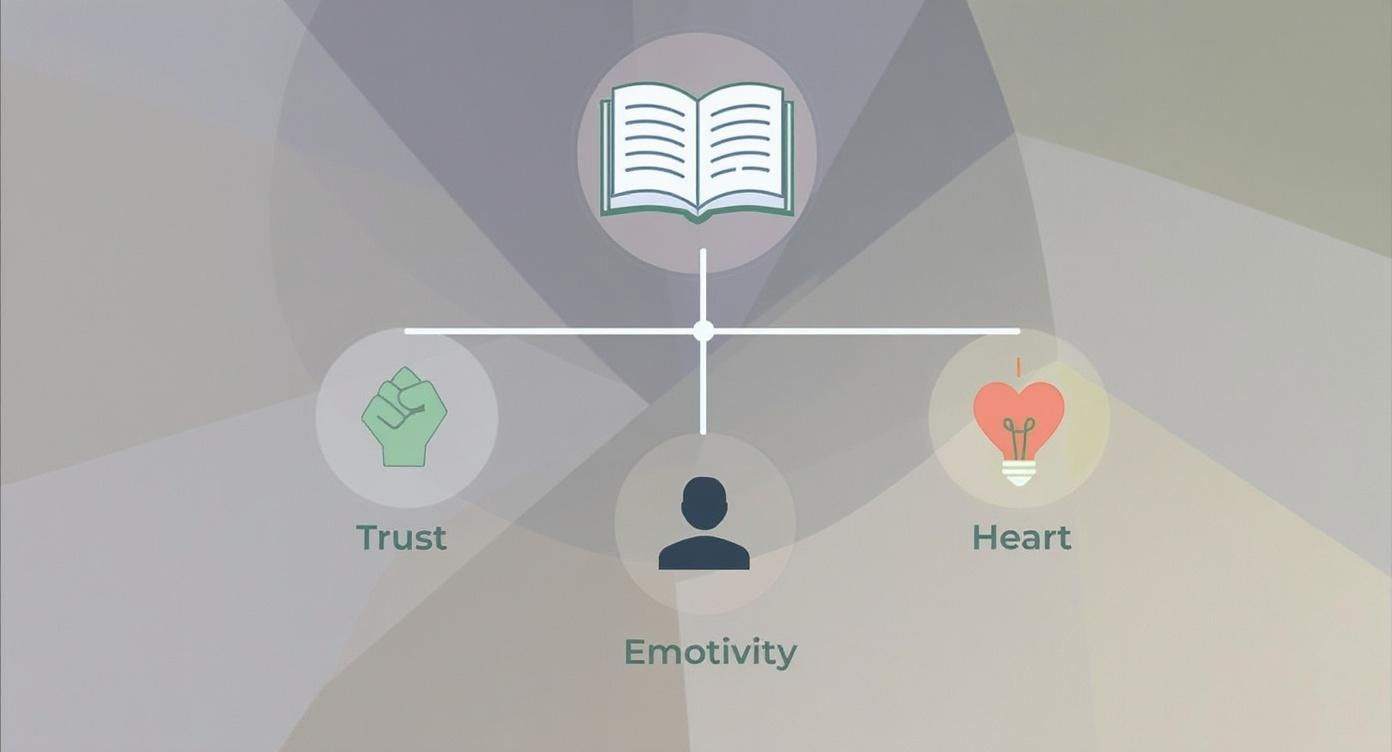
This infographic simply shows you how to identify your child's primary need — whether it be confidence, emotions, or creativity — to choose a book that suits them.
Matching the child's needs to book themes
This chart is a helpful guide to guide you in choosing the right book, based on the challenges your child faces or the skills you'd like to help them develop. It connects a specific situation with the type of story that would best suit it.
| Child's need or challenge | Recommended book theme | Example of an objective |
|---|---|---|
| Fear of failure or lack of confidence | Stories about perseverance and courage | Encourage the child to try without being afraid of making mistakes. |
| Difficulty managing anger or sadness | Stories about emotional intelligence | Helping the child to recognize, name and accept their emotions. |
| Shyness or difficulty making friends | Stories about friendship and empathy | Give him examples of how to approach others with kindness. |
| Lack of inspiration or frequent boredom | Books that stimulate the imagination and curiosity | Nurture their creativity by showing them that everything can become an adventure. |
By following this approach, you no longer choose a book at random. You select a powerful and suitable tool, a story that will speak directly to your child's heart and help them grow a little more peacefully each day.
Our selection of the best books for growing up
Finding the perfect book for your child is a bit like a treasure hunt. To help you navigate the options, we've put together a small selection of our favorite gems. They're categorized by major themes—those that truly matter in helping our children thrive. Each book has been chosen for its ability to spark conversations and plant seeds that will grow with them.
It's no coincidence that the personal development section is booming in France: it already represents a significant portion of the book market. This clearly demonstrates that more and more parents, like you and me, are looking for practical tools to support their children. To delve deeper into the subject, you can take a look at the dynamics of the personal development market.
Books to boost self-confidence
Self-confidence is that little voice inside that encourages your child to dare, to try, to take the plunge. And to nurture that voice, books are wonderful allies. They present heroes who doubt themselves, who fall, but who always find the strength to get back up. It's the best way to show that failure is just a step, not an end in itself.
A good book on this subject doesn't just say "be brave." It gives a concrete example, a character your child can identify with.
- For children who are afraid of failure: Focus on stories that celebrate perseverance. Think of the character who learns to ride a bike and falls ten times before finding their balance.
- For those who compare themselves a lot: Choose stories that highlight each person's unique talents. The idea is to show them that everyone has something special to offer.
A child who follows the adventures of a hero who overcomes his fears is not just reading a story. He is making that possibility his own. He is learning that courage is not about not being afraid, but about acting despite it.
An idea to try as a family: After reading a book about courage, ask your child to tell you about a time they were brave, even if it was for something very small. Celebrate it together to reinforce this positive feeling!
Books to help you navigate the rollercoaster of emotions
Anger, sadness, joy... Between the ages of 6 and 12, emotions can feel like real inner storms. Putting words and images to what's happening inside is a key step in learning to manage them. The best self-help books on this topic act a bit like an emotion decoder.
They allow the child to feel less alone in the face of this whirlwind, by showing them that everyone experiences these roller coasters.
A prime example is The Colour of Emotions by Anna Llenas. This classic book associates each emotion with a colour, providing a very simple visual guide for children to express what they are feeling, even when they lack the words.
A handy tip: The book can become a real tool at home. Why not make an "emotions wheel" together? When your child feels overwhelmed, they simply point to the color that corresponds to their mood. This is often the perfect starting point for a calm discussion.
Books to spark creativity
Creativity isn't just for artists! It's primarily the ability to see things differently, to find original solutions to everyday problems, and to dare to think outside the box.
- Stories that break the mold: Opt for books where the heroes solve puzzles in surprising ways or invent incredible things with next to nothing.
- Albums that are a source of inspiration: Sometimes it is the illustrations or the very format of the book that makes you want to draw, to tinker, to create in your own way.
By choosing the right books, you are doing much more than telling them a story. You are giving them tools to better understand themselves, interact better with others, and build a rich and solid inner world.
Transform reading into a special family ritual.
Finding that rare gem, the perfect self-help book for your child, is already a great victory. But the real turning point, the one that changes everything, is when reading becomes an eagerly anticipated moment, a true ritual of shared connection that sets the rhythm of your family life.
The idea is not to devour books one after another, but to savor the moment. When this reading time becomes a precious appointment, you're not just turning pages: you're weaving memories and helping your child absorb the powerful messages of the story.
This enthusiasm for books that help children grow is very real. Just look at the key figures in the publishing sector : they show that these books hold a prominent place in family libraries.
Go beyond the words of history
For a book to truly open the doors to discussion, it needs to be brought to life. The goal isn't to interrogate your child, but to invite them to share their thoughts and feelings, so they can truly make the story their own.
Your best allies for this? Open-ended questions. They are much more powerful than a question that results in a simple "yes" or "no," because they invite reflection and empathy.
Here are some ideas to start the conversation:
- "If you were in the hero's place, how would you have felt?"
- "If you were the character, what would you have done differently?"
- "Does this situation remind you of anything you've experienced before?"
Each question asked with kindness is like a door you open to your child's inner world. It is by building bridges between the story and their own life that the book's lessons take on their full meaning and become truly ingrained.
Make reading lively and interactive
For 6-12 year olds, interaction is the secret! Never hesitate to spice up reading a little to make it more fun and turn it into a little shared adventure.
Here are a few tips to liven up your reading time:
- Act out the scene! Suggest that your child act out a passage from the book. It's a fantastic way to explore the characters' emotions by "experiencing" them for real.
- What if we changed the ending? Let your child rewrite the story. It's excellent for stimulating their creativity and ability to imagine solutions.
- The emotion "detector": While you're reading, take a break and ask them to guess what a particular character is feeling. It's a little game that helps them better understand and name emotions.
By incorporating these simple habits, you're doing much more than just reading a story. You're creating a safe space where your child learns to think, express themselves, and get to know themselves better. And along the way, you're strengthening your bond, page after page.
Using a journal to solidify learning

The book is finished, the last page is turned. Now what? How can we ensure that the valuable lessons it contains don't vanish like leaves in the wind? The solution is simple: transform reading into an active experience. That's where a creative journal, like the My Book Story notebook, becomes a wonderful ally for your child.
Imagine this journal as a bridge connecting the world of the book to his own inner world. It's his own space, free from judgment, where he can explore the book's ideas at his own pace. With his words, his drawings, his collages… in short, with all his creativity. It's by reclaiming the story in this way that the messages truly take root.
Turning ideas into concrete actions
Moving from reading to drawing or writing is not insignificant. This simple change of activity pushes your child's brain to process information much more deeply. They no longer simply understand an idea; they are invited to explore it, feel it, and give it form.
A well-designed journal gently accompanies this exploration, never turning it into a school exercise. The idea is not to write a summary to get a good grade, but rather to create a personal and sincere connection with the book's message.
Simply writing or drawing one's thoughts helps a child organize their emotional world. It's a dialogue with oneself that strengthens self-esteem and the ability to understand one's feelings.
To make the magic happen, present this activity as a game, an adventure, and definitely not as homework. Let them make their journal their own. Even if they only fill in a small section or prefer to doodle rather than write, that's perfect. It's their space.
Fun activities for each theme
What's great about a journal is its versatility. It adapts to any of the best self-growth books you choose, always offering an activity to extend the journey. Here are a few ideas to inspire you:
- After a book about courage: "Do you remember the hero? What if you drew a picture of a time when you, too, were super brave? It could be when you dared to ask a question in class, or the time you slept without a nightlight."
- After a story about managing anger: "The little dragon's anger was like an erupting volcano. And yours, what does it look like? Draw it, so we can understand it better together."
- After a story about friendship: "The character shared their snack to make a new friend. Write or draw three simple things you could do for a friend this week."
These little prompts help your child connect the story to their own life. By using a journal like My Book Story , you offer them a true companion on their journey to explore their emotions and build their confidence, page by page.
How to find your way through the jungle of children's books?
Entering the children's section of a bookstore can be a little overwhelming, can't it? You're quickly bombarded by hundreds of colorful covers. The real question is: how do you spot that hidden gem, the book that will truly resonate with your child, amidst all those that merely scratch the surface? The goal isn't to find a "perfect" book, but to discover one that will genuinely speak to your child, while also aligning with what matters to you.
It's not just a feeling. Personal development has become a huge market, and its popularity has led to a flood of publications. It's therefore become difficult to distinguish between the gems and the more marketing-driven books. If the subject interests you, you can consult this analysis of the personal development market to see the scale of the phenomenon.
The signs of a really well-made book
A good self-help book for a child never preaches. On the contrary, it tells such a captivating story that the child identifies with the characters and naturally draws their own lessons. It's the subtlety of the message that makes all the difference.
To help you see things more clearly, here are a few points to check before proceeding to checkout:
- Is it really appropriate for his age? The vocabulary, the complexity of the story, and the themes need to be suitable for a child between 6 and 12 years old. The book should be easy to understand, but not childish.
- Are the characters engaging? Do the heroes have flaws, fears, moments of doubt? A character who is too smooth or perfect is boring, and above all, we cannot identify with them.
- Is the message subtle? Are the life lessons smoothly woven into the narrative, or does it feel like reading a manual of good behavior? A good book makes a child think, not recite a lesson.
A quality book trusts your child's intelligence. It holds up a mirror so they can understand their own emotions and opens windows onto the emotions of others. All this, with the simple pleasure of immersing themselves in a beautiful story.
Choose a book that reflects who you are
Beyond its merits, it's important that the book aligns with your family's values. Every household has its own vision of resilience, empathy, or success. The book you choose will become a springboard for your discussions.
Before you decide, take a moment to ask yourself:
- What vision of conflict does this book offer? Does it emphasize listening, seeking compromise, or another approach?
- How does the book address success? Is it a matter of competition and performance, or rather of collaboration and perseverance?
- Does the story encourage curiosity and open-mindedness? Do the characters and situations value difference and diversity?
Keeping these questions in mind, you won't just choose a good book. You'll choose an ally who will help you share what's essential to you. And that's how reading becomes a true moment of sharing and connection within the family.
We answer your questions
Are you wondering about personal development books for your child? That's perfectly normal, and even a very good thing! Here are some answers to help you make an informed and reassuring decision.
At what age should I start?
From the age of 6 , sometimes even a little before, children are like sponges for emotions. They love stories that talk about friendship, courage, or self-confidence.
Your child's exact age matters less than their maturity. Look for books with engaging illustrations and a simple, positive message. The magic ingredient? Reading with them. This shared moment makes the experience much more powerful and allows you to ensure they've understood the message.
What if my child doesn't take to the book?
Above all, never force him. Reading should remain a pleasure, not a chore. If he doesn't like a book, see it as a great opportunity to talk and better understand what's going on in his mind.
Simply ask them what bothered them: the story, a character, the art style? Their answers are valuable clues to their current tastes and needs. Put that book aside and suggest choosing another one with you next time. Problem solved!
A book is not a magic bullet. It is first and foremost a gateway. Its true strength lies in opening a compassionate dialogue and helping you put words to emotions that are sometimes complicated.
Are these readings really effective?
A book won't transform behavior overnight, that's for sure. But it's a fantastic way to spark conversations and small realizations. It offers your child concrete examples and heroes they can identify with.
By using it as a tool for discussion, you help them find new ideas for managing their anger, fears, or simply boosting their confidence. It's a true team effort, and the book is your best ally in this endeavor.
To ensure these valuable lessons don't just stay on paper, the My Book Story notebook is the perfect companion. It helps your child transform each story into a personal and creative adventure, all their own. Discover the My Book Story Notebook to solidify key messages while having fun.