


Far from being reserved for adults, the best personal development books are true treasures for children aged 6 to 12. They transform concepts like self-confidence or managing emotions into exciting and easy-to-understand adventures , thus laying the foundations for lasting personal growth within the family.
Why read self-help books with your child?
Personal development for a child is a bit like tending a secret garden in their mind. A plant needs water and light to grow, doesn't it? Well, a child needs tools to cultivate their confidence, creativity, and resilience. Books are the seeds of this inner garden, and as a parent, you are the best gardener.
Forget complicated manuals. The best self-help books for this age group tell stories that resonate with children. They help them put words to emotions that are sometimes a little unclear. A character who learns to overcome shyness or manage anger becomes a friend, an inspiring role model.
Tools to face everyday challenges
These readings become true points of reference for facing the small and large challenges of everyday life, while strengthening family bonds.
- Emotional intelligence : A book can help your child understand why their friend is sad, or why they feel frustrated after losing a game. It's a perfect opportunity to talk together about their feelings, without judgment. Parenting tip : After reading about anger, ask them, "And how does it feel in your body when you're angry? Where do you feel it?"
- Self-esteem : By connecting with heroes who doubt themselves but ultimately succeed, he strengthens his own self-esteem. He understands that making mistakes is simply a step in the learning process. This is a valuable lesson for him, and a reminder for us, as parents.
- Resilience : Stories where characters get back up after a failure teach a fundamental lesson: it's okay to fall, what matters is getting back up. This is a foundation for building one's ability to overcome difficulties.
This image illustrates well how reading together can create a space of trust, a true "secret garden", to discuss these big ideas.
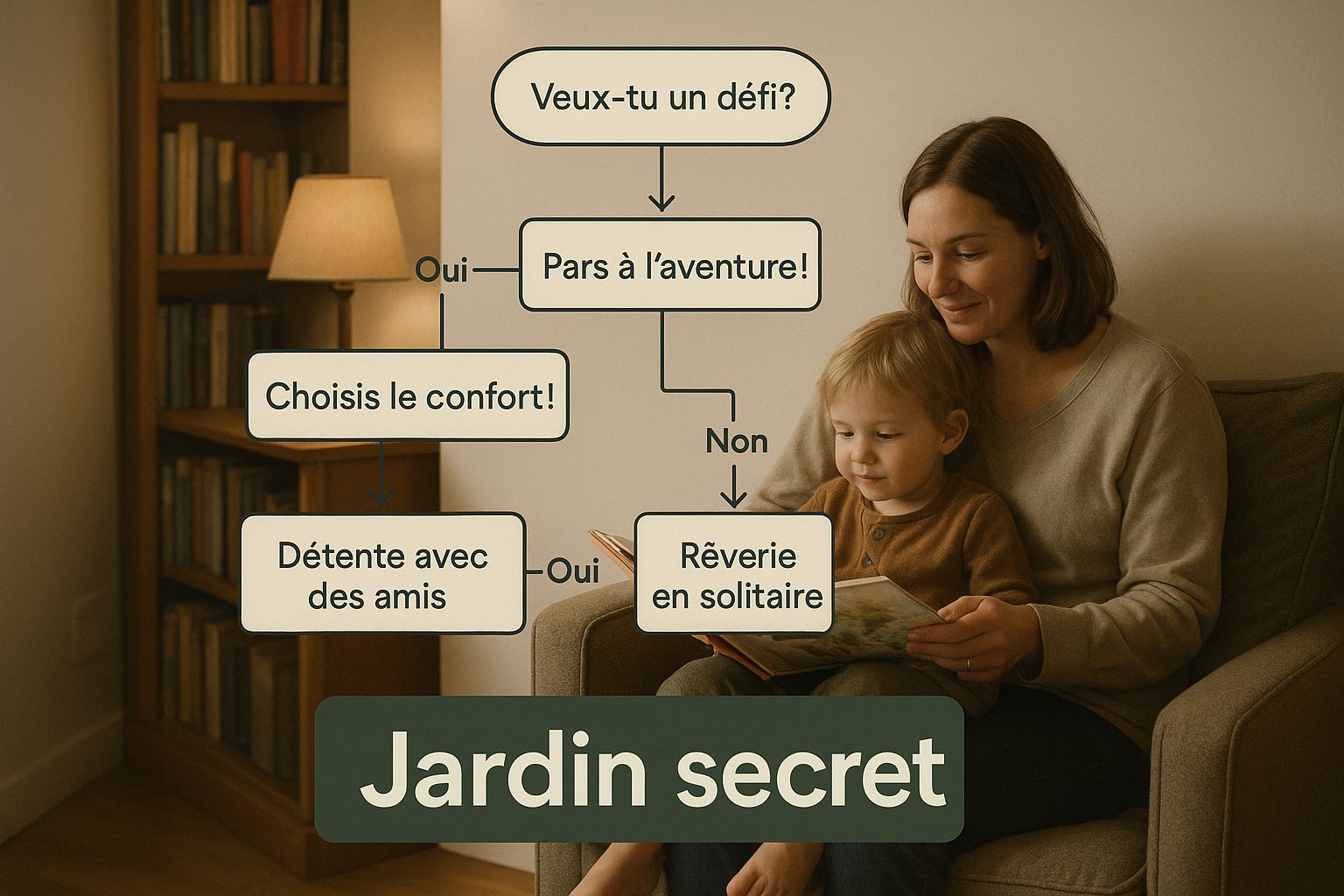
As a parent, you become a caring guide in this exploration. Reading time then transforms into a strong and special family ritual.
A trend that reflects a need for family well-being
This growing interest is no coincidence. It reflects a broader quest for well-being within families. In France, the personal development market is experiencing impressive growth. In 2021 alone, sales of books in the "health, well-being, and personal development" categories jumped by 19.8% in value. This signals a collective desire to find ways to better manage emotions, both for oneself and for one's children. To delve deeper, you can explore this dynamic within the publishing market.
The greatest gift you can give your child isn't a ready-made answer, but curiosity and the tools to find their own answers. Books are among the very first of these tools.
By choosing the right books, you're doing much more than just reading a story. You're giving your child an inner compass that will guide them throughout their life. You're simply teaching them to become the hero of their own adventure.
How to choose the right book for your child
Choosing a personal development book for your child is a bit like introducing them to a new friend. You hope it will be inspiring, that it will listen to them and help them grow. But how do you find that rare gem, the one that will truly speak to them, amidst crowded bookstore shelves?
The secret is to go beyond the age indicated on the cover. Every child grows at their own pace, both emotionally and cognitively. A good book must, above all, speak their language and capture their imagination, without ever giving the impression of being preachy.
Think beyond the recommended age
Your best guide is your child's emotional maturity. A very sensitive 7-year-old won't have the same needs as another child of the same age who is more adventurous and extroverted. Before choosing, ask yourself a few simple questions.
- What's bothering him right now? Does he have butterflies in his stomach before going to school? Is he having trouble making friends? Or is he full of questions about the world around him?
- What is his attention span? Is he more comfortable with short, highly illustrated stories, or can he already immerse himself in a longer narrative?
- What kind of hero inspires him? Does he need to see himself in characters who resemble him, with their doubts and minor imperfections?
A book that arrives at just the right time can have a huge impact. It puts words to what the child is feeling and simply shows them that they are not alone in experiencing this.
Favor a language that inspires
The tone of the book is absolutely essential. The best self-help books for children are never moralizing. They don't impose lessons, but rather open doors for discussion and reflection together.
Look for books that use positive and encouraging language. The best stories are those that invite your child to explore their own solutions, instead of giving them ready-made answers. The idea is to nurture their self-confidence, their belief in their ability to think and overcome obstacles.
The goal isn't to find a book to "fix" something in your child, but rather a book that helps them discover their own strengths. It's an invitation to adventure, not a prescription.
Illustrations also play a crucial role. Far more than mere decorations, they are the gateway to the story. Vivid, expressive, and colorful images captivate the attention of 6- to 12-year-olds and help them understand the characters' emotions. The narrative immediately becomes more accessible and easier to remember.
Seeking interaction and identification
A book truly comes into its own when a child can see themselves in it. Look for heroes who aren't perfect. A character who makes mistakes, who is afraid but finds the courage to try, is so much more inspiring than a flawless superhero.
Interactive formats are also an excellent way to engage your child. A book that asks questions, offers little games, or invites drawing transforms reading into a truly personal experience. The connection between your child and the book's message will only be stronger.
To help you see things more clearly during your next visit to the bookstore, this small table summarizes the criteria to keep in mind.
Criteria for choosing the right personal development book
This quick guide is designed to help you assess and choose the book best suited to your child's specific needs.
| Criteria | Why this is important | Concrete example for an 8-year-old child |
|---|---|---|
| Emotional maturity | Ensures that the message is understood and relevant to the child's current challenges, without overwhelming them. | Choose a book on frustration management if he has trouble losing at board games. |
| Positive language | Build confidence and optimism, instead of creating guilt or pressure. | Opt for a story that says "Try again, you'll succeed!" rather than "Don't do that, it's wrong." |
| Imperfect Hero | It allows the child to identify with the situation and understand that everyone has difficulties to overcome. | A story where the hero is afraid of the dark but learns to tame his imagination. |
| Living illustrations | They capture attention, facilitate the understanding of emotions, and make reading more fun. | Colorful drawings that clearly show the joy, sadness, or anger of the characters. |
| Interactive format | It transforms reading into an active experience and encourages the child to apply the concepts to their own life. | A book that asks: "And you, what makes you brave?" and leaves space to draw. |
Keeping these points in mind, you will not just be choosing a book, but a true companion for your child.
Our selection of books to build rock-solid self-confidence
Self-confidence is that little inner engine that pushes a child to explore, to dare, and to get back up when things don't work out the first time. It's that little voice that whispers "you can do it" just before they take the plunge. To nurture that voice, books are wonderful allies for us parents.
Rather than a simple list, here are books that make reading a concrete and interactive experience. Each story is a perfect opportunity to discuss courage, self-acceptance, and the pride of achieving success on one's own.
The Courage to Be Yourself by Todd Parr
With its colorful illustrations and simple sentences, this book is ideal for helping a child understand that their uniqueness is a strength. It doesn't follow a traditional plot, but rather presents a series of situations that celebrate differences and encourage pride in what makes us unique.
The message is direct and powerful: whether you love eating macaroni in the bath or need a nightlight at night, you're perfect just the way you are. It's an excellent starting point for a no-nonsense discussion about self-acceptance and acceptance of others.
Parenting tip for a family ritual
After reading, why not start a "pride box" at home? Everyone can slip in a note or drawing about something that made them proud this week. It's a simple ritual to get into the habit of recognizing your own successes and those of other family members.
When I feel... Aurélie Chien Chow Chine's self-confidence
From a collection that children adore, this book features an endearing little character who explores what it means to "have confidence." It talks about doubts, the fear of making mistakes, but also the immense joy one feels when finally succeeding on their own.
What's really great about this book is that it completely demystifies emotions. It shows that doubt is normal, and it provides concrete strategies for overcoming fears. It perfectly illustrates that confidence is built little by little, success after success.
Confidence cannot be imposed, it must be cultivated. Every book that helps a child put words to their emotions and celebrate their efforts is a small seed planted for their future.
Moreover, this interest in wellness tools is not insignificant. Did you know that 35% of French people read at least one self-help book per year? This is a sign that we are all looking for ways to feel better. You can learn more about the appeal of personal development on the ELLE.fr website.
Vashti and the Point by Peter H. Reynolds
This is a wonderful story about the fear of the blank page and the magical moment when you discover your own talent. Vashti is convinced she can't draw. Until the day her teacher encourages her to make a simple mark: a dot.
This book is a beautiful metaphor for the courage to simply try. It teaches children (and us too!) that the most important thing isn't to do things perfectly, but simply to begin. It's an essential lesson for overcoming the perfectionism that sometimes paralyzes us.
Some ideas for further exploration after reading
- Launch this week's "courage challenge" : Each family member suggests a small thing to step outside their comfort zone. It could be trying a new food, saying hello to someone new at school, or trying a game for the first time.
- Organize a "dots" exhibit : Give your child a sheet of paper and ask them to make a single dot. Then, frame their artwork and hang it on the wall like a masterpiece. It's a very symbolic way to show them that even the smallest effort deserves to be celebrated.
By combining these readings with concrete activities, the positive messages take lasting root. They are no longer just stories, but real moments of sharing that strengthen family bonds and build, brick by brick, your child's self-esteem.
Unleash creativity and imagination through reading
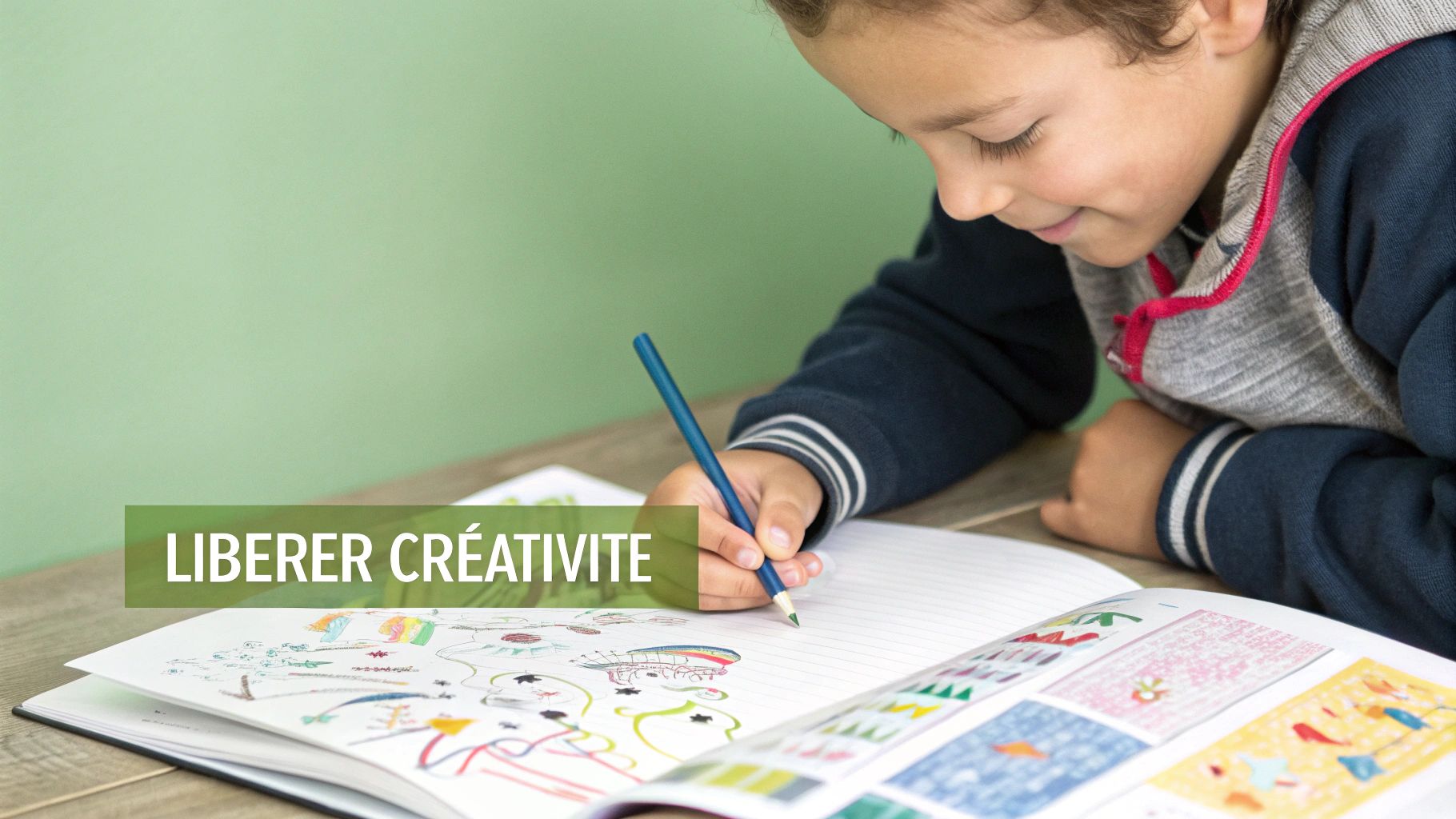
Creativity isn't a magical gift that falls from the sky and is reserved for a lucky few. No, it's more like a muscle. The more you train it, the stronger it becomes. It's a mindset that can be cultivated, starting from a very young age. For a child, learning to be creative is first and foremost about learning to invent their own solutions, to adapt, and not to panic in the face of the unknown.
Some of the best self-help books are veritable gyms for the imagination. They don't just tell a story; they invite the child to become its co-creator. These books are designed for one simple purpose: to show that play and experimentation are at the heart of personal growth.
When books invite action
The secret of these books, unlike any other? They break the mold of the passive reader. Instead of simply following a story, they ask questions, pose challenges, and leave plenty of room for the child's imagination.
Imagine a book that gives you story beginnings to finish, little puzzles to solve, or even drawing challenges. The child is no longer a passive observer; they take control. It's an incredibly effective method for overcoming the dreaded fear of the "blank page."
Creativity isn't about waiting for inspiration to knock on the door. It's about simply starting. A book that encourages a child to doodle, write, or invent teaches them this essential lesson: the act of creating matters far more than the final result.
By encouraging experimentation without the pressure of results, these books convey a fundamental truth: there are no "right" or "wrong" answers in creativity. There are only ideas, and all are worth exploring.
How to make reading a family adventure
These books are fantastic springboards for creative activities to do together. The idea is to extend the adventure long after turning the last page. Play then becomes the best way to anchor the book's lessons in everyday life.
Here are a few simple ideas to transform reading into a creative ritual:
- Invent the sequel : The book is finished? Perfect! Ask your child, "What do you think happens to the hero next?" You can even make it a collaborative story, where everyone takes turns adding a sentence.
- Build an object from the book : Does the main character have an awesome cabin or a spaceship made of odds and ends? Suggest that your child make it with what you have on hand: cardboard boxes, toilet paper rolls, bottle caps… It’s a great way to work on problem-solving while having fun.
- Create an "emotions treasure map" : If the book is about emotions, draw a map of an imaginary island together. Each place represents a feeling (the Forest of Anger, the Lake of Calm, etc.). This is an opportunity to talk about what the characters felt and to place everything on your map.
Play, a pillar of personal development
This play-centered approach to reading offers much more than just entertainment. It teaches children that creativity is first and foremost a fun adventure, without the pressure of having to "succeed".
Here's why it's so effective for 6-12 year olds :
- It takes the drama out of failure : By focusing on the process and not the result, the child understands that making mistakes is part of the game. A cardboard tower that collapses is not a failure; it's an opportunity to think about how to make it stronger.
- It strengthens flexibility of mind : Inventing the end of a story or figuring out how to make a castle out of cereal boxes develops the ability to see multiple solutions to the same problem.
- It strengthens the parent-child bond : Creating together means sharing a powerful experience. These moments of play become precious memories that build complicity and trust.
By choosing books that spark the imagination and using them as a starting point for family activities, you're giving your child much more than just a story. You're giving them the tools to become a creative, curious, and confident thinker, ready to imagine their own path.
Turn reading into action with a personal journal
After sharing an inspiring story, we often wonder: how can we ensure these beautiful messages don't vanish once the book is closed? It's an excellent question. If the best self-help books plant little seeds in our children's minds, a personal journal is a bit like a watering can that helps them grow.
This is where tools like the My Book Story notebook become truly valuable. It bridges the gap between the inspiration of a story and the child's real life. It's a space all their own, a nurturing haven where they can translate the lessons of books into their own world.
This type of journal provides a simple framework for him to put words to his emotions, to connect the adventures of his heroes with his own experiences, and, above all, to feel heard. It's a gentle and playful way to introduce him to self-reflection.
Create a small ritual around the newspaper
Keeping a journal can quickly become a cherished and eagerly anticipated family ritual. Forget about homework! Think of it instead as an opportunity to get together and talk about what truly matters. After reading in the evening, taking a few minutes to fill in the journal together opens the door to incredible conversations.
This special moment is an opportunity to ask open-ended questions about the story, the characters, and what your child felt. You might be surprised by the depth of their reflections when they are given the space to express themselves, without judgment.
The journal transforms a somewhat abstract word like "courage" into a concrete discussion about one's own life. It helps the child realize that the superpowers of heroes are qualities they already possess, ready to be explored.
This more interactive approach is, in fact, a genuine underlying trend. Personal development represents a huge share of the book market in France, approximately 32% of the overall market. The arrival of tools such as apps and guided journals clearly demonstrates the desire to make this learning more concrete. To delve deeper, you can read this very interesting analysis on the success of personal development .
Making big ideas concrete with very simple questions
The true magic of a guided journal lies in its ability to anchor lessons. It's no longer about telling a child "be brave," but about helping them remember times when they have already been brave, without even realizing it.
Very simple questions can have a huge impact:
- "Tell me about a time you felt brave this week?" Suddenly, a vague concept becomes a lived experience: daring to speak up in class, tasting a new food, or trying a game that was a little scary.
- "Draw a moment that made you happy today." This simple invitation helps her notice the small joys of everyday life and cultivate a sense of gratitude, quite naturally.
- "In your opinion, what would the hero of the story have done in your place?" Projecting oneself in this way encourages him to imagine different solutions to a problem, which stimulates his creativity and his ability to find solutions.
The newspaper: a playground for the mind
A journal is not just a place to write. It's also a space to draw, doodle, dream, in short, to create! The blank page becomes an invitation to express oneself freely, without the pressure of having to "do it right".
The My Book Story journal, for example, offers a structured space on one side for putting words to emotions and needs, and on the other, a completely blank page to let the imagination run free. This balance is essential: it provides a reassuring framework while encouraging autonomy and creativity.
Using this type of tool, your child learns, page after page, to:
- Getting to know oneself better : By highlighting his emotions and small victories, he builds a fairer and more positive self-image.
- Sharpening his critical thinking skills : By going back and forth between the stories and his own life, he learns to analyze situations and to think for himself.
- Developing emotional intelligence : Putting words to what one feels is the very first step in learning to manage one's emotions in a healthy way.
Ultimately, a personal journal is much more than just a notebook. It's a true companion that helps your child transform the lessons from books into solid life skills, for today and for tomorrow.
Some questions you might be asking yourself
Diving into the world of personal development with your child is a wonderful adventure, but it also raises a lot of questions. That's perfectly normal! To help you see things more clearly, we've compiled the most frequently asked questions from parents, with simple and straightforward answers.
The goal is to make this experience a truly shared, positive, and enriching moment for the whole family. Forget the pressure and the demands; we're here to explore together.
At what age should we start, specifically?
There's no magic age, but the period between 6 and 12 years old is a real playground for this. It's at this time that children begin to ask deeper questions about themselves, their friends, and the world around them. They become capable of grasping slightly more abstract concepts like courage, perseverance, and empathy.
Before age 6, the focus is mainly on recognizing basic emotions with highly illustrated picture books. After age 6, they are ready for more complex stories that address everyday situations and encourage them to reflect on their feelings. The most important thing is to choose a book that matches their emotional maturity, not just their age on their ID card.
What if my child doesn't take to it right away?
Above all, don't panic and don't force anything. If a book doesn't appeal to them, it's absolutely fine. Reading should remain a pleasure, not another item to check off a to-do list. Rather than insisting, try to dig a little deeper to understand what the problem is.
Here are some ideas for a smooth transition:
- Try a different format . The traditional story format might not be suitable for this topic. Why not try a more interactive book, with games or creative activities?
- Explore another theme . If he's not excited by a book on self-confidence, a story about friendship, anger management, or creativity might interest him much more.
- Put the book on hold . Put it away on a shelf and take it out again in a few months. Sometimes it's just not the right time. What leaves him indifferent today might fascinate him tomorrow.
The real goal isn't to finish the book at all costs, but to open a door to discussion. If a single page has sparked an interesting exchange between you, then the book has already done a good part of its job.
Won't these books put pressure on him?
That's a perfectly legitimate fear. It all depends on how you, as a parent, approach things. The best self-help books for children aren't manuals for becoming perfect. They're more like mirrors that help them understand themselves better, and windows that show them other children are going through similar experiences.
To avoid falling into the trap of pressure, adopt a "curious explorer" mindset. The idea isn't to tell him, "See, you should do like the hero," but rather to start a conversation: "And you, what do you think? Have you ever felt like that?"
The discussion after reading is often more important than the story itself. It's this moment of sharing that transforms a simple message into genuine personal reflection. You're not there to lecture them, but to explore ideas with them, in a supportive and encouraging environment.
How can we find the time in an already overloaded daily life?
Let's be honest, our days are packed. The idea isn't to add another task to your to-do list, but rather to enrich an existing moment. The bedtime story ritual, for example, is perfect for this. Ten or fifteen minutes is more than enough.
For it to work, it's better to prioritize regularity over duration. Reading together for fifteen minutes three times a week will be much more effective than an hour-long session on Sunday evening.
Also, remember to leave the books in a prominent place. If they're accessible in his room or the living room, he'll be more inclined to browse them on his own, whenever he feels like it or needs to. Little by little, he'll become familiar with these resources and use them independently. And ultimately, that's the whole point.
The My Book Story journal is the perfect companion for delving deeper into the story after reading. It allows you to transform the messages of books into reflections and fun, concrete actions. It's a space all their own to continue their exploration, at their own pace. Discover how this tool can enrich your family reading ritual on the My Book Story website .