Learning to manage emotions: a guide to support your child aged 6 to 12
Share
Guiding your child through the jungle of their emotions is a bit like teaching them to read a treasure map. Each emotion, far from being an obstacle, is actually a valuable clue leading to their deepest needs. By giving them the tools to decode these messages, you're not just helping them feel more at ease every day. You're nurturing their self-confidence and their ability to build strong relationships with others.
Why is it so important to guide your child with their emotions?
Learning to navigate the world of emotions is one of the greatest gifts you can give your child. Between the ages of 6 and 12, it's a period of great upheaval: challenges at school, friendships that form and dissolve… All of this generates feelings that are sometimes very intense.
Without the right tools, frustration over a math assignment or sadness after an argument can quickly seem like insurmountable mountains.
As a parent, your role is not to make these emotions disappear, but rather to be a caring guide. It's about showing them how to navigate these inner waves without ever getting swept away.
The superpowers of good emotional support
Emotional intelligence is a key skill that will positively impact all aspects of your child's life. Helping them develop it now will bring benefits for a very, very long time.
Rock-solid self-confidence : A child who understands what's happening inside feels less lost. They discover they have the resources to face challenges, and that's a real boost to their self-esteem.
Better relationships with others : To understand others, you must first understand yourself. This is the basis of empathy, an essential quality for making friends and maintaining healthy relationships.
A boost for school : A child who knows how to calm their stress before an assessment or manage their frustration with a difficult exercise will be much more focused and persevering.
Armor for the future : Developing these skills early means building better resilience against life's hard knocks.
The stress of everyday life doesn't just affect adults. A study by the Ramsay Santé Foundation revealed that over 59% of French people feel stressed . And for nearly 39% of them, this stress has a direct impact on family life. By giving your child tools to manage their emotions, you help them navigate this situation more effectively. To learn more, you can consult the details of this study on stress and its impact.
Your support is a safety net. You create a space where every emotion, even the most unpleasant, has the right to be there, without being judged.
In short, teaching him to manage his emotions is giving him an inner compass that will serve him throughout his life. It's showing him that, no matter the storm, he will always find his way back to calm.
Identifying emotions beyond words
To help a 7-year-old learn to manage their emotions, you must first help them recognize them. When they slam a door, they are not just expressing anger: it is often a sign of frustration , a feeling of injustice, or even jealousy towards a brother or sister.
Between the ages of 6 and 12, a child's emotional landscape becomes richer. It's no longer just about the four basic emotions. Pride after a successful presentation or anxiety before a competition are nuances you can help them understand.
As a parent, you take on the role of a benevolent investigator. The goal? To decode the hidden message behind every gesture and every word.
Giving a face to feelings
Explaining an abstract emotion to a child can seem complicated. However, a few playful tools are enough to make it concrete and reassuring.
Instead of asking the classic "How are you?", invite him to explore his emotions through creative activities you can do together:
Personalized emotion wheel : Take a paper plate and draw different faces. Joy, sadness, excitement, surprise… a rotating arrow allows it to indicate its current state.
Illustrated emotion cards : On each card, write a word like "frustrated" and on the back describe a situation ("when my puzzle doesn't finish"). This links the emotion to a concrete experience.
Anger thermometer : A graduated drawing from "everything's fine" to "I'm going to explode" helps her gauge the intensity of the feeling. You can intervene before things get too out of hand.
The goal is not to judge the emotion, but to acknowledge it. By saying, "I see that you are really disappointed," you validate their feelings and show them that they have the right to feel that way.
Enriching one's emotional vocabulary represents the first step in emotional development. When a child moves from "I'm useless" to "I'm frustrated because this exercise is difficult," they regain control over the situation.
This small shift in perspective is enormous. It transforms an attack on his own value into a concrete problem he can act on, rather than letting it explode or implode.
To go further, this table can help you interpret certain common behaviors and open the dialogue in an appropriate way.
Identify the emotions hidden behind the behaviors
Observable behavior of the child
Potential emotion to explore
Example sentence to open the dialogue
Slam a door
Frustration, feeling of injustice
"I see you closed the door hard, how do you feel?"
Refusing to speak
Sadness, shame
"You're silent, is something weighing you down?"
Withdraw into oneself (avoid group activities)
Fear of judgment, anxiety
"I've noticed you're keeping to yourself, what's stressing you out?"
Crying for no apparent reason
Disappointment, feeling of abandonment
"Your tears surprise me; has something disappointed you?"
Use this chart as a guide to ask open-ended questions and help your child put words to their emotions.
Practical tools to calm emotional storms
Now that your child can put words to their feelings, a new stage begins. It's time to give them the keys, the concrete tools to navigate their emotions without being overwhelmed by them. The goal isn't to put out the fire, but to teach them to become a skilled and confident firefighter in the face of their own inner storms.
For younger children, between 6 and 8 years old , the most effective techniques often involve the body. Their minds are still very connected to their physical sensations. Therefore, it is quite naturally through play and movement that they will best learn to regain their calm.
For 6-8 year olds: we use the body
At this age, big abstract concepts are a bit complicated. It's better to offer him simple, visual tips that he can easily grasp.
Balloon breathing: Tell them to place their hands on their stomach. As they inhale through their nose, they imagine they are slowly inflating a large balloon. Then, as they exhale through their mouth, the balloon deflates. This simple exercise helps them slow their heart rate and return to the present moment.
The turtle pose: When he feels overwhelmed or very angry, suggest he retreat into his "shell." He can sit down, bring his knees to his chest, and rest his head on them. This pose creates a physical refuge that reassures him, a safe little cocoon where he can let the storm pass.
A great family activity is to create a "calm box." Take a pretty box and fill it together with soft-textured objects, small balls to squeeze, soothing drawings, or even a scent they love, like lavender. It will be their personal emotional first-aid kit.
Of course, these tools are not magic wands. For them to become true reflexes when a crisis erupts, you need to practice a little, using them regularly as a family when everything is going well.
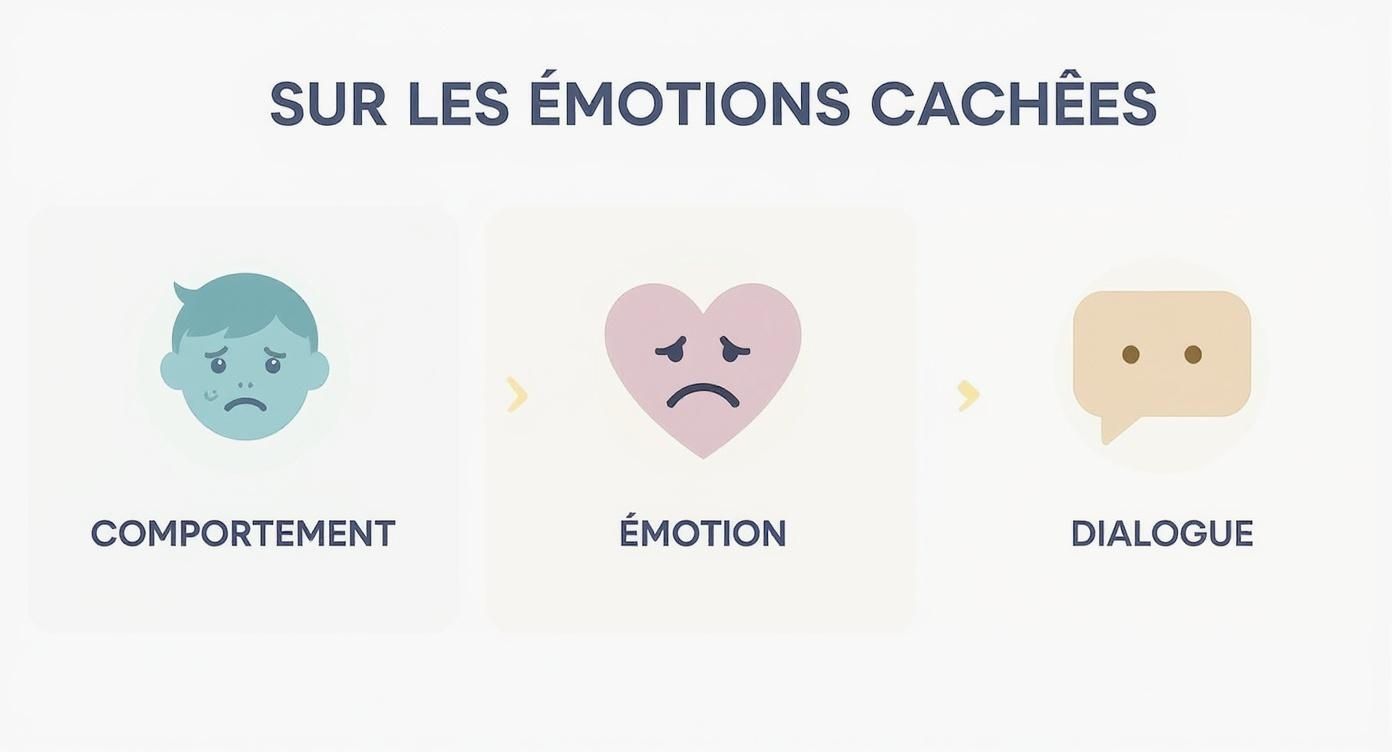
The infographic below clearly shows how visible behavior can hide a completely different emotion, and how to engage in dialogue to respond appropriately.
This image reminds us that behind a big tantrum, there is often sadness or frustration. It's a valuable reminder: we must always look beyond the surface to truly help our child.
For 9-12 year olds: we start thinking together
As children approach pre-adolescence, they become more capable of introspection. At this stage, we can begin to offer them strategies that draw upon their reflective abilities to help them learn to manage their emotions .
They can begin to analyze their thoughts and actively seek solutions. It is also at this age that a personal and healthy outlet becomes essential for their well-being.
The thought detective: When faced with a negative thought like "I'm terrible at math," encourage him to play detective. Is it really true? Has he never even managed to complete a single exercise? This little trick helps him take a step back and avoid seeing everything in a negative light.
The problem solver: Instead of going around in circles, put on your problem-solving hats. "Okay, you're angry with your friend. What could we do to make things better?" List all the ideas together, even the craziest ones, before choosing the most constructive one.
The creative outlet: Sport, drawing, or even writing in a journal like My Book Story are fantastic channels of expression. They allow you to transform raw emotion into something concrete and controlled.
This period coincides with a heightened sensitivity that seems increasingly prevalent in our society. The 2023 "France Emotions" barometer revealed that nearly half of the French population has felt more emotionally sensitive since March 2021. By teaching them these techniques, you equip them with valuable skills to navigate a world where managing emotions is a challenge for everyone. You can find more information on the findings of this study .
By adapting the tools to their age, you turn each crisis into a valuable opportunity to learn and strengthen your family bond.
Integrating emotional intelligence into your family rituals
Learning to manage your emotions isn't a formal evening lecture. It's more about a series of small, shared moments, firmly rooted in your daily life.
These simple habits are not a constraint: they strengthen family ties and create an atmosphere of listening where everyone feels recognized.
The internal barometer at dinner
Dinner is an ideal time to reconnect. Instead of asking a banal "How was your day?", suggest an internal check-in .
Everyone can describe their "sky" of the day with its nuances:
“I felt a great sunshine in my heart: I succeeded with my drawing and the teacher congratulated me.”
“It was a bit stormy: I was stressed during recess because I couldn’t find my friends.”
This fun little ritual helps your child put words to their feelings, without pressure. You also show them that there's no such thing as bad emotional weather and that even parents have rainy days.
Stories as a mirror of emotions
A film, a novel, or a comic book: each story is teeming with characters grappling with their feelings. It's a perfect opportunity for discussion.
Ask open-ended questions:
“How did you feel when the hero lost his friend?”
“What would you have done in his place?”
These interactions develop empathy and emotional vocabulary. Your child understands that their emotions are universal and less isolating.
Key to calm communication Validating an emotion before seeking a solution sends this message: “I hear you, I understand what you’re going through, and you matter to me.”
A place to find peace and quiet
When emotions overwhelm you, it's helpful to have a refuge. Create a calm space together in their bedroom or a corner of the living room.
Make it welcoming with:
A soft rug or thick cushions
A soft little blanket
Calming items: stress ball, felt-tip pens and sketchbook
This personal sanctuary becomes a place where your child can breathe, release their inner turmoil, and return calm. By repeating these rituals, you transform the home into a true emotional training ground.
Creativity, another language for emotions
Sometimes, words are not enough. When an emotion is too intense or too vague, your child may feel helpless, unable to put words to what they are feeling.
It is precisely in these moments that creativity becomes an incredible ally. It offers him another way to express himself, a channel much more direct than speech.
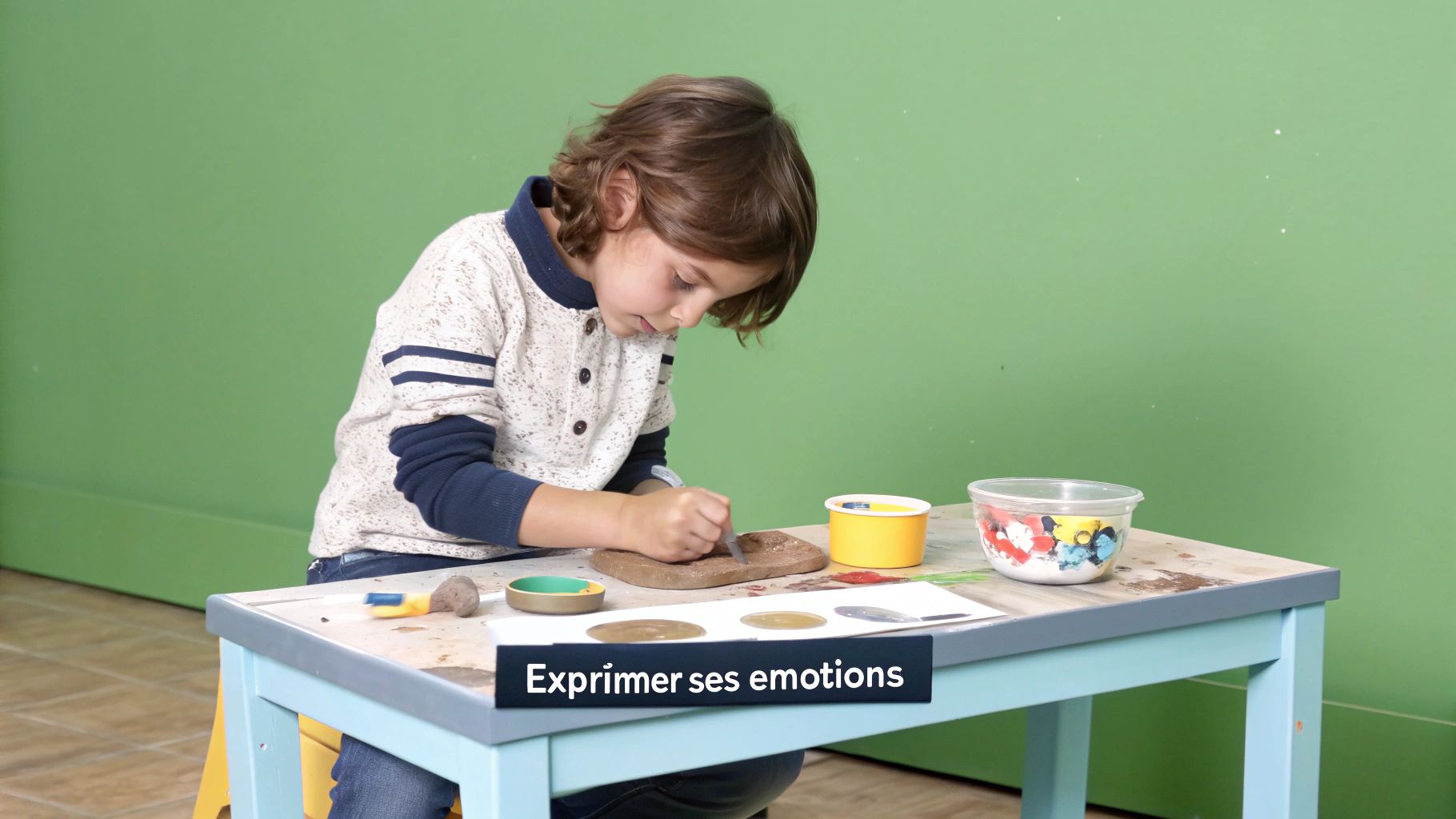
Drawing, painting, sculpting… all these activities allow us to give form, color, and texture to what's happening inside. When you suggest your child "draw their anger," it's not just a pastime. It's an invitation to externalize that big ball of energy in order to better understand it.
The idea is simple yet powerful: an internal feeling, sometimes a little frightening, is transformed into something concrete, something that can be seen and touched. Once sadness has become a salt dough sculpture or frustration has been scribbled on a piece of paper, they immediately seem less intimidating.
Creative activities to let out what's inside
To help your child learn to manage their emotions through art, you don't need to be a great artist. The important thing is never the result, but the process. Here are a few easy ideas to explore as a family:
Puppet theater: Simple socks or favorite toys can become the actors in a scene from school. Replaying the situation allows them to take a step back and imagine other endings, without feeling directly targeted.
The Dance of Emotions: Put on some music! An upbeat song, followed by something calmer. Let him move as he feels. It's a great way to release the tension the body accumulates.
Story writing: What if he invented a hero who feels the same way he does? This character can experience adventures, find solutions, and your child can draw inspiration from his courage to face his own challenges.
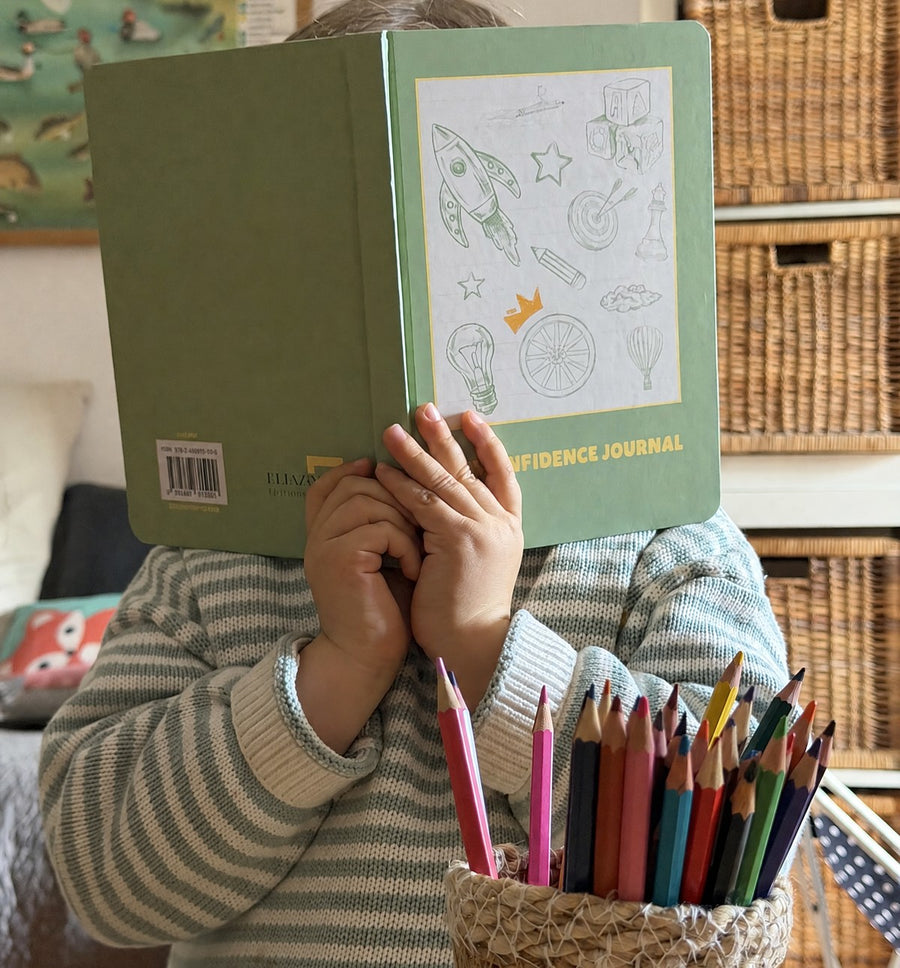
A creative journal, like the My Book Story notebook, can become a true secret garden. It's their own space, a safe place where they can express their emotions with words, drawings, or collages, without fear of judgment.
It's also important to remember that we are not all equal when it comes to emotions. A survey by INSEE (the French National Institute of Statistics and Economic Studies) revealed that women, for example, report lower average emotional well-being than men. 23% of women reported feeling nervous recently, compared to only 14% of men . These figures simply show us that everyone has their own unique sensitivity, which makes creative tools all the more valuable in helping each child find their own way to express themselves. To learn more, you can consult the details on these differences in emotional well-being .
By encouraging him to explore his creativity, you are not just offering him a hobby. You are giving him a toolbox for life, showing him that all his emotions have their place and that there are a thousand and one ways to express them healthily.
Questions that all parents ask themselves
As a parent, you have a thousand questions. That's perfectly normal. Navigating the world of our children's emotions is a bit like learning a new language. Here are a few pointers to help you find your way and give you confidence.
My child doesn't want to talk to me about how they feel. What can I do?
Above all, don't force him. Forcing him to speak is often the best way to block him. Remember that words are just one means of expression among many.
Try suggesting other ways for him to express what he has inside: drawing, modeling clay, or even a simple game of Lego can work wonders.
Sometimes, the best way to open up is you. Lead by example by simply talking about your own feelings, without expecting anything in return. A simple phrase like, "I was a little frustrated with my job today," shows him that it's normal and safe to share his feelings. He'll talk when he feels safe to do so.
My 10-year-old son still throws huge tantrums, is that normal?
Yes, absolutely. It's actually very common. At this age, children face increasingly complex social and academic challenges. A major tantrum is often the visible sign of overflowing frustration or a feeling of helplessness in the face of a situation that overwhelms them.
The goal is not to suppress anger, but to teach her to channel it in a healthier way. You could suggest:
Hitting a cushion to release physical tension.
Go for a short run outside if you have a garden.
To write or scribble down anything that makes him angry on a piece of paper.
The most important thing is to validate what he's feeling first and foremost. Tell him: "I see that you're very angry, and you have every right to be. Together, we'll find a way to weather this storm without hurting anyone."
And what do I do when I'm at my wit's end dealing with his emotions?
This is a situation all parents know. The first thing to do? Stop feeling guilty. Recognizing that you're overwhelmed is already a big step. You have the right to set your own limits.
Don't hesitate to say it simply: "Right now, I'm feeling my temper rising. I need to take a couple of minutes to breathe alone in another room to calm down." By taking care of yourself, you're showing them concretely what it means to learn to manage their emotions . It's a powerful and genuine example.
The My Book Story journal was designed precisely for this purpose: to offer your child their own space to draw, write, and put words to what's happening inside. It's a wonderful tool for transforming those sometimes difficult moments into a creative and soothing ritual for the whole family. Take a look at how it could help you in your daily life on the My Book Story journal page .