


The 5-minute journal is a simple ritual, inspired by positive psychology, to help your child focus on the good moments of their day and express gratitude. It's a gentle and effective way to cultivate their emotional well-being, self-confidence, and strengthen your family bonds.
What is a 5-minute news report for a child?

Imagine a little ritual that can brighten your child's day. That's exactly what the 5-Minute Journal offers—much more than just a secret diary. Designed for children aged 6 to 12 , it's a fantastic tool that teaches them, day after day, to cultivate a positive mindset and better understand their emotions.
This special time, which you can establish in the morning for a good start or in the evening for a gentle end, encourages the child to recognize small joys, set positive intentions, and develop self-confidence. Far from being a chore, it's a small seed of well-being that you sow every day.
A treasure chest for good times
The idea is simple and fun: think of this journal as a kind of personal treasure chest. Each day, your child adds a few "nuggets": a fun game in the playground, a big hug, or the pride of finishing a puzzle. It's not a strict writing exercise, but rather a treasure hunt for positive memories.
Through this approach, children learn to:
- Spotting the positive : They train their attention to notice the small joys of everyday life that would otherwise go unnoticed.
- Putting words to their emotions : Knowing how to name what makes them happy is a key step in developing their emotional intelligence.
- Building up a bank of positive memories : Flipping through one's journal becomes a source of comfort and an excellent reminder of one's abilities and worth.
The principle behind the 5-minute journal is to establish a positive habit without it becoming a chore. By focusing on what's going well, your child trains their brain to see the glass as half full, a fundamental skill for building resilience in the face of life's challenges.
This method is inspired by principles of positive psychology, whose benefits for well-being are well-known. For parents who wish to learn more, there are excellent resources on the Five Minute Journal that explain its origins. In France, the pursuit of well-being is a major concern, as various statistics on well-being in France demonstrate.
By introducing your child to this practice, you are giving them a precious gift that will stay with them for a long time and strengthen their self-confidence for years to come.
The newspaper's superpowers for its development
More than just a simple habit, the 5-minute journal is a true gift for your child's development. In just a few minutes a day, you create a space for them to grow, build their confidence, and better understand the world around them.
This simple practice acts as a springboard for key skills. It helps your child build a solid foundation for their future well-being, transforming small daily reflections into significant self-discoveries.

Developing your emotional intelligence
One of the first superpowers your child will develop is emotional intelligence. By inviting them to identify a "happy moment," you give them the tools to put words to what they are feeling. Moving from a simple "I'm happy" to "I was happy because I managed to build my whole LEGO tower" is a giant leap in self-understanding.
This daily exercise teaches him to recognize and name his emotions, whether it be pride, joy, or even frustration in the face of an obstacle. It's an essential skill that will help him throughout his life to better understand himself and clearly express his needs.
By becoming familiar with their own emotions, your child also develops empathy. Understanding their own joy or disappointment allows them to better recognize and respect the feelings of others, whether at school or at home.
Building unshakeable self-confidence
Each day, the journal invites your child to write down a small victory. It can be something as simple as "solving a difficult puzzle," "helping Dad set the table," or "reading a page of my book all by myself." Once written down, these small successes become part of their memory.
They become tangible proof of his abilities and progress. The accumulation of these successes, even the smallest, builds genuine and solid self-confidence. He no longer just has a vague memory of having done something well; he has a written record of it.
A ritual that strengthens family ties
The 5-minute journal isn't a solitary exercise. It's a wonderful opportunity for sharing. By accompanying your child, you create a special moment, a sincere conversation about the little and big events of their day. It's the perfect time to listen without judgment and to value what they've experienced.
This ritual strengthens your bond and transforms a simple exercise into a precious shared memory. You can even keep your own journal alongside him, creating a powerful sense of connection and mutual support.
Start your journaling ritual in a few simple steps
Integrating a new habit into a family's busy daily life can seem like a daunting task. But rest assured, establishing the 5-minute journal ritual is much simpler than it appears. The idea isn't to add another "task" to the list, but rather to create a little bubble of connection and serenity.
The key to success? Present it as a special moment, a little secret date between your child and their notebook... and maybe you. By following a few tips, you'll see that these few minutes will quickly become an eagerly anticipated and precious ritual for everyone.
Choosing the right time and the right place
For a habit to become ingrained, it needs to be regular and associated with a pleasant context. Choose a quiet time, when no one is rushing. For many families, the ideal time is just before bedtime stories. The day is over, the hustle and bustle has subsided, it's perfect for relaxing. It can also be in the morning, during breakfast, to start the day off right.
Create a cozy little corner: a few cushions on the floor, a soft blanket, a dim light... You don't need much. This dedicated space signals to your child that it's a special time, entirely for them and their thoughts, away from screens and everyday distractions.
A simple structure to guide the child
A blank page can sometimes be a little daunting, especially for a child. That's where the magic of the 5-minute journal comes in: it offers a simple and reassuring structure that serves as a guide, without ever being rigid. The goal is to ask open-ended and positive questions that encourage reflection while having fun.
Here is a table that summarizes this simple approach, designed to organize the routine effortlessly.
Simple structure of the 5-minute journal
| Time of day | Main objective | Examples of questions for your child |
|---|---|---|
| The morning | Start the day with a positive intention | - "What would make you happy today?" - "Imagine the coolest thing that could happen to you." - "How are you feeling this morning, like sunshine or a little cloud?" |
| The evening | Enjoy the beautiful moments of the day | - "What was your favorite moment today?" - "Tell me about a nice thing you did, or that someone did for you." - "Did you learn anything new or funny?" |
This framework helps to transform a simple sheet of paper into a true playground for emotions and memories.
This simple visual process shows how the journal structures the child's day, from morning to night.
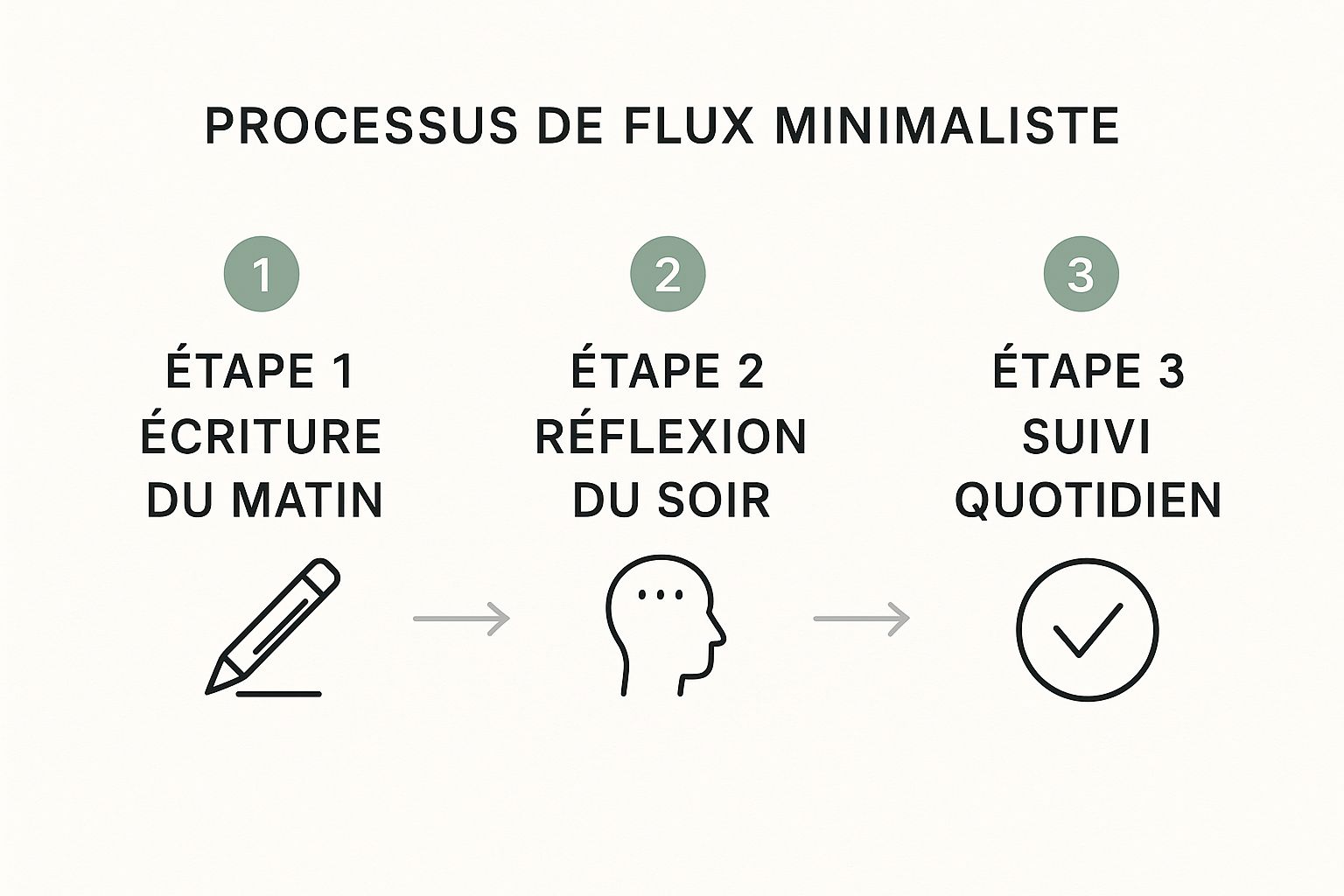
This infographic perfectly illustrates this natural flow: you plant a small seed of intention in the morning, and you reap the fruits of the day in the evening. That's how you gradually build a wonderful habit of well-being.
Create an atmosphere of total trust
Perhaps the most important point of all is that this journal should be a space of complete freedom, free from judgment. Reassure your child that this notebook is their private sanctuary. There are no "right" or "wrong" answers. And above all, forget about correcting spelling mistakes!
The goal is not perfection, but expression. By valuing her thoughts and emotions as they are, you send her a powerful message: "What you feel is important and legitimate."
Your role is that of a caring guardian. If your child wants to share what they've written, listen attentively and with curiosity. If they prefer to keep it to themselves, respect their privacy. It is in this secure environment that their honesty and creativity can truly flourish.
To make the moment even more special, why not add a little treat? Soft music playing in the background, a hot chocolate to sip... These little details matter. They transform a simple habit into a comforting ritual, a moment he'll associate for a long time with a feeling of well-being and connection.
Personalizing the journal: a tailor-made tool for each child
Every child is unique. They have their own way of seeing the world, their own passions, their own emotions, both big and small. For the 5-minute journal ritual to truly work, it must adapt to this unique personality. If too rigid a framework is imposed, the exercise risks quickly becoming a chore. The goal, however, is quite the opposite: to create a space of freedom where they feel comfortable.
The key is to see this journal not as homework, but rather as a toolbox. Depending on your child's age and personality, you can pick and choose, adapt, and invent new ideas to make this time entirely theirs.
For younger children (6-8 years old): play is paramount
At this age, holding a pencil and forming sentences can require considerable effort. The important thing isn't to write well, but to be able to express what's on your mind. The approach should therefore be fun, creative, and very visual.
For a young child, writing is just one language among many. Limiting them to words would be a mistake that could quickly discourage them.
Here are some simple ideas for 6-8 year olds:
- Drawings of emotions: Rather than writing, why not draw the "best moment" of the day? A simple smiling face, a scene of play with bright colors… a drawing can say much more than a sentence.
- Weather stickers: Keep a small collection of stickers handy: suns, clouds, stars, hearts. Each evening, he can choose the one that best represents how he felt during his day.
- Dictation to an adult: Sometimes ideas flow freely, but the hand doesn't follow. Suggest that they become your child's personal scribe. They write, you write. It's a wonderful moment of connection that shows your child that their thoughts have value.
For older children (9-12 years old): dig a little deeper
As children grow, their inner lives become more complex and their thinking more refined. A journal can then evolve with them, becoming a true companion for exploring their emotions and the challenges of their daily lives.
They are now capable of reflecting on themselves. This is the right time to introduce questions that lead them to analyze their experiences and strengthen their ability to bounce back.
At this age, a journal evolves from a simple album of happy memories into a genuine space for self-reflection. It is here that children learn not only to express their feelings, but also to ask themselves why.
For example, you could expand on the questions a little:
- In the morning: "What small thing could you do today to help someone?" or "What challenge would you like to take on today?"
- In the evening: "What difficulty did you encounter and how did you overcome it?" or "What new things did you learn about yourself?"
This approach helps them build strong self-confidence by making them realize that they are capable of overcoming obstacles.
Adapting to your child's temperament
Beyond age, every child has their own style. A highly creative child will not keep their diary in the same way as a more down-to-earth child or a sports enthusiast.
A child with an artistic soul will readily transform their journal into a sketchbook, pasting in photos or images that inspire them, or even writing short poems. The right-hand page of the My Book Story journal, intentionally left blank, is a true canvas for expression for this type of personality.
A more pragmatic or athletic child might enjoy listing their concrete goals and achievements: "successfully juggle 10 soccer balls," "finish chapter 5 of my book." It's a way for them to see their progress in black and white, which is very motivating.
The most important thing is that the journal remains his secret garden, a place where he feels totally free to be himself.
Keeping motivation intact, even on bad days
The initial enthusiasm is wonderful. But the real strength of the 5-minute journal lies in its long-term viability. It's perfectly normal for your child's motivation to fluctuate. The goal isn't perfection, but gradually building a positive habit that finds its place in your family life.
Consider the following your little emergency kit for those days when inspiration is lacking or fatigue takes over. With a few tips, you'll see that these small obstacles are actually great opportunities to make this ritual even stronger, more personal, and more fun for your child.
What to do when the answer is "nothing"?
It's a classic scenario. You ask your child to recount a great moment from their day, and the answer comes quickly: "nothing" or "I don't know." Don't panic! It's often just a sign that they need a little help to jog their memory of happy times.
The secret is to ask the question differently, in a more concrete and fun way. Instead of a vague question, try a more precise approach:
- "When did you laugh the most today?" This one works almost every time, because it calls upon a specific and lighthearted memory.
- "Tell me about something fun you did at recess." By focusing on a specific moment, ideas flow more easily.
- "What is the nicest thing that was said or done to you today?" This helps her focus on positive interactions with others.
These questions are like little keys that unlock the door to memories. They are less intimidating and transform the search into a detective game of everyday joys.
Incorporate journaling into a routine you already enjoy
To help a new habit stick, the easiest way is to link it to an existing ritual. Think of a time of day when you already share a quiet moment with your child. That's the perfect place to slip in the journal.
The idea is to link the journal to an activity your child already enjoys. The positive association will then occur naturally, and the ritual will become a seamless extension of a pleasurable moment, rather than an additional chore.
For example, the moment just before bedtime stories is ideal. Once in pajamas, snuggled up under the covers, taking out the newspaper becomes the first step in the bedtime ritual. For others, it will be snack time, a chance to unwind after school. The key is to find your own time slot, the one that fits your family's rhythm.
Go for it and participate with him
Your own commitment is the best encouragement. A child will be much more motivated to participate if they see that it's a moment that matters to you too. Take a few minutes to fill out your own notebook or, even simpler, share your answers aloud.
Share your own moment of gratitude, or your small victory of the day. The exercise then transforms into a genuine exchange. Not only do you set an example, but you also create a space for sincere sharing where everyone feels heard. It's the best way to keep the spark alive and make this journal a little treasure for the whole family.
Your questions (and our answers) about the 5-minute children's news program
Do you have questions about the 5-minute journal ? That's great news, it means you're about to get started! Here are a few things to clarify to help you and your child begin this wonderful adventure smoothly.
At what age can one start?
There's no hard and fast rule, but the ideal age is often around 5 or 6. The most important thing is to adapt the method to the child's level. For toddlers who aren't yet comfortable with letters, a drawing or a few words dictated to mom or dad works wonderfully.
The idea is simply to get into the habit, to start putting words or images to what you're feeling. You can take it easy, starting with just one question, like: "Draw me the best thing that happened to you today."
What if my child doesn't want to write every day?
Above all, no pressure! Flexibility is key. Journaling should remain a pleasurable experience, never a chore. If you lack motivation one day, don't force it. The most important thing is to preserve the positive and joyful aspect of this ritual.
To keep the conversation flowing, offer a simple alternative: "No problem! So, just tell me something that made you smile today." Preserving this little moment of sharing is much more important than filling the notebook at all costs.
The goal isn't to tick boxes, but to cultivate well-being. Writing a few times a week, if that suits your pace, is already perfect.
Should you correct your spelling mistakes?
No, absolutely not! It's a golden rule. This journal is his private sanctuary, a place where he can express himself freely and safely. Turning it into a school assignment would risk stifling his spontaneity and making him feel judged.
Raw emotion and thought always take precedence over form. What should be encouraged is his effort, his frankness, and the courage he has to share what's on his mind. It is by feeling heard and trusted that he will develop a taste for expression.
The My Book Story journal was designed precisely for this purpose: to accompany your child on this inner exploration, but in a fun and creative way. Discover how it can become their best ally for growing up by taking a look at our page: The My Book Story Journal .