


Have you heard of the 5-minute journal ? It's a simple way to help your child cultivate gratitude and self-confidence by dedicating just a few minutes a day. Think of it as a fun tool that transforms journaling into an enjoyable and easy family ritual, even for younger children.
Why five minutes a day is enough for your child

Between work, school, and other activities, our lives as parents are already quite full. Adding a new task to the schedule can quickly seem like an impossible mission. That's precisely where the magic of the 5-minute journal comes in. Forget the long diary that can seem intimidating for a child aged 6 to 12. Here, everything relies on the strength of simple family routines.
The principle is child's play: a few moments in the morning to set a positive intention, and a few minutes in the evening to reflect on the pleasant moments of the day. This approach, both short and regular, is designed to fit naturally into your routine, whether at breakfast or just before bedtime stories.
A small family ritual, with big effects on its development
Make no mistake: these five short minutes have a huge impact on your child's well-being. For them, this brief moment becomes a safe haven where they can explore their emotions and celebrate their small victories, even the most discreet ones, with you by their side.
This daily ritual helps him in a concrete way to:
- Putting words to his emotions : He learns to better identify and express what he feels. For example, instead of just saying "things aren't going well", he can say "I'm sad because...".
- Seeing the bright side of life : He practices focusing on the positive aspects of his day, such as a compliment from the teacher or a game shared with a friend.
- Boosting his confidence : He becomes aware of his successes ("I succeeded in my math exercise") and his qualities ("I am a good friend").
By making introspection a quick and fun game, the 5-minute journal opens the door to greater emotional intelligence, without ever feeling like a chore. It's a true personal development tool for children.
Ultimately, it's not the duration that counts, but rather the regularity. This simple daily ritual lays the foundations for lasting well-being and, as a bonus, strengthens that precious bond you share.
The treasure hidden behind the 5 Minutes newspaper

Forget the traditional homework notebook. Think of the 5-minute journal instead as a personal treasure chest. Every day, your child can slip in their most precious thoughts: a fit of laughter, a small moment of pride, a slightly crazy dream. Far from being a chore, it's a game that invites them to collect little nuggets of happiness every day.
The idea is disarmingly simple. It's a journal guided by short, positive questions. A few in the morning to start the day off right, and a few more in the evening to wind down gently. This simple and playful approach transforms writing into a truly enjoyable moment of self-discovery.
How does it work, in practical terms?
This journal is structured around two short sessions per day. Each has a specific purpose to help your child cultivate a positive and confident mindset.
-
The little morning ritual: The goal? To plant seeds of optimism for the day. Questions like "What am I grateful for?" or "What great thing could happen today?" help them envision the future with a positive outlook. It's an excellent exercise to start school off on the right foot.
-
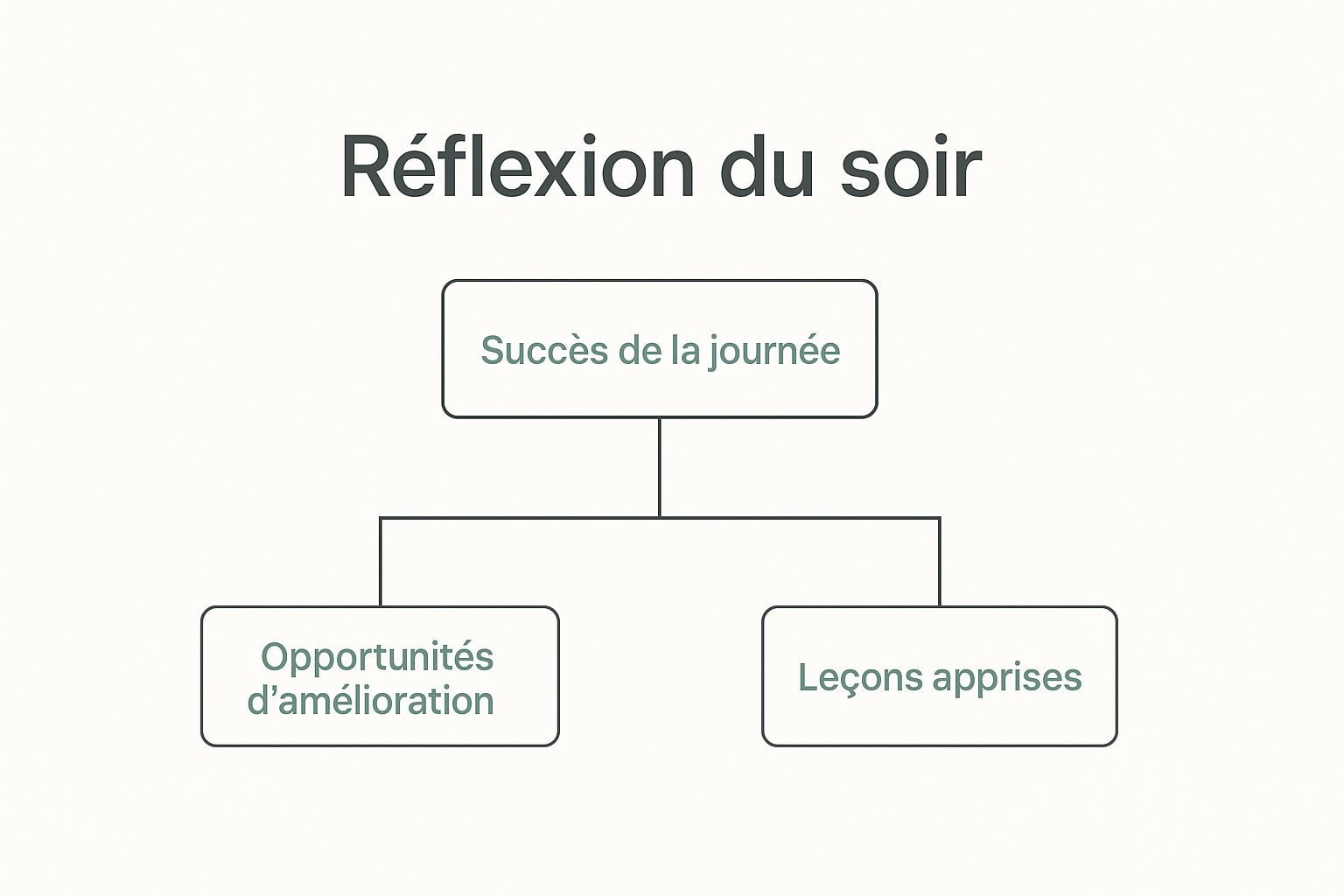
Evening review: It's time to reap the rewards! We look back on what went well. Questions like "List 3 amazing things that happened today" or "What new things did I learn?" encourage them to see their successes and value their learning.
This practice reflects a broader trend: integrating moments of positive reflection into our busy lives. In fact, nearly 42% of French people who keep a personal journal choose a quick, gratitude-focused format, very similar to the spirit of the 5-Minute Journal . If this topic interests you, you can explore statistics on cultural practices to learn more.
The goal isn't perfection, but connection. This journal becomes a safe space where your child learns that every day, even the most ordinary, contains something beautiful to celebrate. It's an incredibly powerful tool for building self-esteem.
What are the benefits for your child?
The 5-Minute Journal is much more than just a notebook. It's a true little secret garden where your child's heart and mind can flourish. In just a few minutes each day, this simple ritual helps them cultivate essential skills that will last a lifetime.
It's a concrete and gentle way to strengthen emotional intelligence and self-confidence, one small seed at a time. The practice is particularly beneficial for 6-12 year olds , the age when they begin to explore the sometimes complex world of their own emotions.
Developing your emotional intelligence
Putting words to what you feel is the very first step in learning to manage your emotions. A journal offers a safe, non-judgmental space where your child can write, "Today I'm so happy because I managed to ride my bike without training wheels" or "I feel a little sad because my friend didn't want to play with me."
This habit helps him enrich his emotional vocabulary, a key skill for better self-understanding and, of course, better communication with you and others.
The effects of this practice are very real. A 2023 survey of the "5 Minute Journal" app revealed that 57% of adult users saw their mood improve in just three weeks. Even though the study focused on adults, it demonstrates the power of this method to shift our mindset. An equally valuable benefit for our children! You can find the details of this study here .
Strengthening his self-confidence, day after day
Self-esteem is built on small, everyday victories. The 5 Minutes newspaper encourages your child to celebrate their successes, even the simplest ones: helping a friend, finishing a difficult drawing, or overcoming a small fear.
By writing them down in black and white, he anchors them in his memory and forges a positive image of himself.
The journal changes the way your child sees their days. Instead of only remembering what went wrong, they learn to recognize and savor the moments when they were proud of themselves.
This table summarizes the main benefits of journaling for child development, with concrete examples for each point.
Impact of the 5-minute journal on your child
| Skills developed | A concrete example from his daily life |
|---|---|
| Gratitude | He notices and appreciates the little things: Grandma's delicious cake, a moment of play with Dad, a hug. |
| Emotional Intelligence | He manages to say "I'm angry" instead of just sulking, which makes communication easier within the family. |
| Self-esteem | After successfully completing a difficult task, he told himself "I am capable" instead of doubting himself. |
| Growth mindset | He sees failure in a game not as a fatality, but as an opportunity to learn for next time. |
| Optimism | He focuses on the 3 positive things from his day, even though everything wasn't perfect at school. |
In summary, each page turned is a stone added to the building of her confidence and well-being.
Encouraging a growth mindset
Finally, a question like "What did you learn today?" is incredibly powerful. It transforms the notion of failure into a simple learning step. Your child realizes that every experience, whether successful or not, is a lesson.
This approach allows him to develop a growth mindset . He understands that his abilities are not fixed and that he can always progress with a little effort. This is an immense gift that helps him become more curious and resilient in the face of life's challenges.
How to lead a journaling session with your child

Making a 5-minute journal a moment of connection and enjoyment is much simpler than it seems. The trick is to approach it like a game, a little creative break just for the two of you, and definitely not like an extra assignment. The goal here isn't perfection, but sharing and connection.
For the magic to happen, the atmosphere is key. Settle into a cozy little corner that invites intimacy: on the sofa with lots of cushions, on a soft rug, or perhaps in a makeshift hideaway in their room. This little haven will quickly become your personal bubble for sharing.
Good questions to start a conversation
The key to making this moment engaging lies in the questions you ask. They should be captivating and resonate with your child's world. Don't hesitate to mix things up to prevent routine and keep their curiosity alive.
Here are some ideas to get started, which should of course be adapted to the time of day:
- In the morning: "What will your super mission be for today at school?" or "If your day had a color, what would it be and why?". These questions help to envision the day in a positive and creative way.
- In the evening: "Tell me about three little joys that brightened your day" or "What was your favorite moment, and why?". This helps her remember the good things and cultivate gratitude.
The idea is to avoid closed questions that only elicit a simple "yes" or "no." Always prefer open questions that encourage dialogue and imagination.
The most important thing is to listen with genuine attention, without trying to correct or judge. Your child needs to feel that their journal is a safe space where all their thoughts and emotions are welcome, unfiltered.
Transforming the newspaper into a creative game
To make your child look forward to this ritual, make it as visual and fun as possible. Creativity is a wonderful way to express emotions, especially between the ages of 6 and 12 .
Get out your art supplies:
- Felt-tip pens and colored pencils: Suggest that they draw their mood of the day or illustrate a happy memory. Sometimes, a drawing says much more than words.
- Stickers: Stars for small victories, smileys for joys, hearts for moments of gratitude... Stickers make the journal much more lively and personal.
- The magic phrase: To begin, a kind phrase can change everything. Try it with: "I'm looking forward to discovering the treasures of your day. Would you like to tell me about them?"
By making this moment a creative and sensory experience, you transform a simple habit into a precious memory. This 5-minute journal then becomes much more than just a notebook: it's a colorful and authentic reflection of your inner world.
Turning the journal into a family ritual that actually lasts
For a new habit to take root, especially in a child, there's a secret ingredient: enjoyment. The 5-minute journal shouldn't become just another chore. The idea is to transform it into a special family moment, a little ritual everyone looks forward to.
Your role is essential. The easiest way to encourage this is to join in! Take a few minutes to fill out your own journal or simply share aloud the little joys of your day. Your child will see that it's not a school assignment, but a lovely way to feel good together.
Finding the right niche in your daily life
The best time for journaling is simply whatever works for your family. For many, the evening is perfect. Just before the bedtime story or the last cuddle, the atmosphere is already calm and conducive to sharing. It's a great way to soothe minds before drifting off to sleep.
But the golden rule is flexibility . Is your child exhausted one evening? No problem. Forcing things would be counterproductive. The important thing is to keep this time associated with something positive. It's better to skip a day than to turn pleasure into a chore.
The goal isn't to check a box every day. It's to open a little window to chat and connect. If you miss an evening, it's absolutely fine. You can simply pick it up again the next day, without any pressure.
Managing "uninspired" days with gentleness
There will inevitably be days when your child says "I don't know what to say" or simply doesn't feel like it. That's perfectly normal! It's even a wonderful opportunity to show them that you accept their emotions without judgment.
Here are some suggestions for navigating these moments with kindness:
- Suggest a creative alternative : "What if today, instead of writing, you drew what made you happy?" Drawing is another way to express what's on your heart.
- Take the first step : Share your own moment of gratitude or your small victory of the day. Often, that's enough to get people talking and give them ideas.
- Change the question : Try a lighter approach, such as: "What was the funniest thing you heard at recess today?"
By remaining flexible and attentive, you show them that this ritual is a space of freedom, not an obligation. This is precisely the spirit of the My Book Story notebook , which, with its blank pages, invites both drawing and writing. This is how a simple habit gradually transforms into a precious memory.
Your questions, our answers in the 5 Minutes newspaper
Do you still have some questions about the 5-minute newspaper ? That's perfectly normal when you're embarking on a new parenting adventure. Let me shed some light on things so you can confidently start this ritual with your child.
What should I do if my child doesn't yet know how to write well?
Don't panic! The newspaper is a playground, not a French test. If words are still difficult to form, drawings are a perfect solution.
A bright sun to describe a wonderful day, a small cloud for a sad moment… The key is to encourage him to express himself. You can also become his personal scribe and simply write down what he dictates to you. The important thing is to share this moment with him.
My child doesn't want to do it, how should I react?
Above all, don't turn this moment into a chore. If your child is a little sulky, the best approach is to lead by example. Take your own notebook and fill it out next to them, sharing aloud one small thing that made you happy today. Often, curiosity will prevail, and the desire to do as you do will naturally take over.
Do I have the right to read what he writes or draws?
This is a crucial parenting question. Consider this journal as their private sanctuary. Respecting their privacy is key to making this ritual work.
Always ask permission before taking a look. Offer to let them read or show you whatever they'd like , and nothing more. Building strong trust is achieved by showing them you respect their space.
The golden rule is quite simple: her journal is her world. By respecting her privacy, you send her a powerful message: her thoughts and emotions matter, and they deserve to be protected.
The 5-minute journal is an excellent idea from the age of 6. It's a tool that grows with the child, moving from scribbles and drawings to increasingly structured reflections over the years.
So, ready to transform five little minutes a day into a powerful ritual of connection and happiness as a family? The My Book Story journal was designed exactly for that: to accompany your child on this beautiful adventure of personal development.
Order your copy today and start cultivating confidence and creativity, one day at a time.