


Five little minutes that change everything. The idea may seem simple, almost too simple, but that's where the magic lies. The 5-minute journal isn't just another homework assignment to add to the list, but a real appointment your child makes with themselves. It's a short ritual, designed to help them connect with the positive, put words to their emotions, and cultivate gratitude within the family.
The express routine for a big impact
Making a little space for journaling in your child's daily routine, even for such a short time, can truly transform their emotional well-being. Think of it as an intimate and silent conversation, a safe space where they can express their thoughts without fear of judgment.
This special moment quickly becomes a powerful reflex for developing a positive mindset. For children aged 6 to 12 , learning to name what they feel is a key skill for their development. Instead of letting their joys or frustrations build up in silence, they learn to recognize, understand, and express them in a healthy way.
Developing your emotional intelligence, day after day
In practical terms, this practice helps children better navigate their inner world. In just a few weeks, many parents notice that their child is able to verbalize their emotions much more easily, which can reduce tantrums and improve communication within the family.
This infographic clearly illustrates the change: it compares children's ability to identify their emotions before and after adopting this ritual, and also shows the times families prefer to do it.
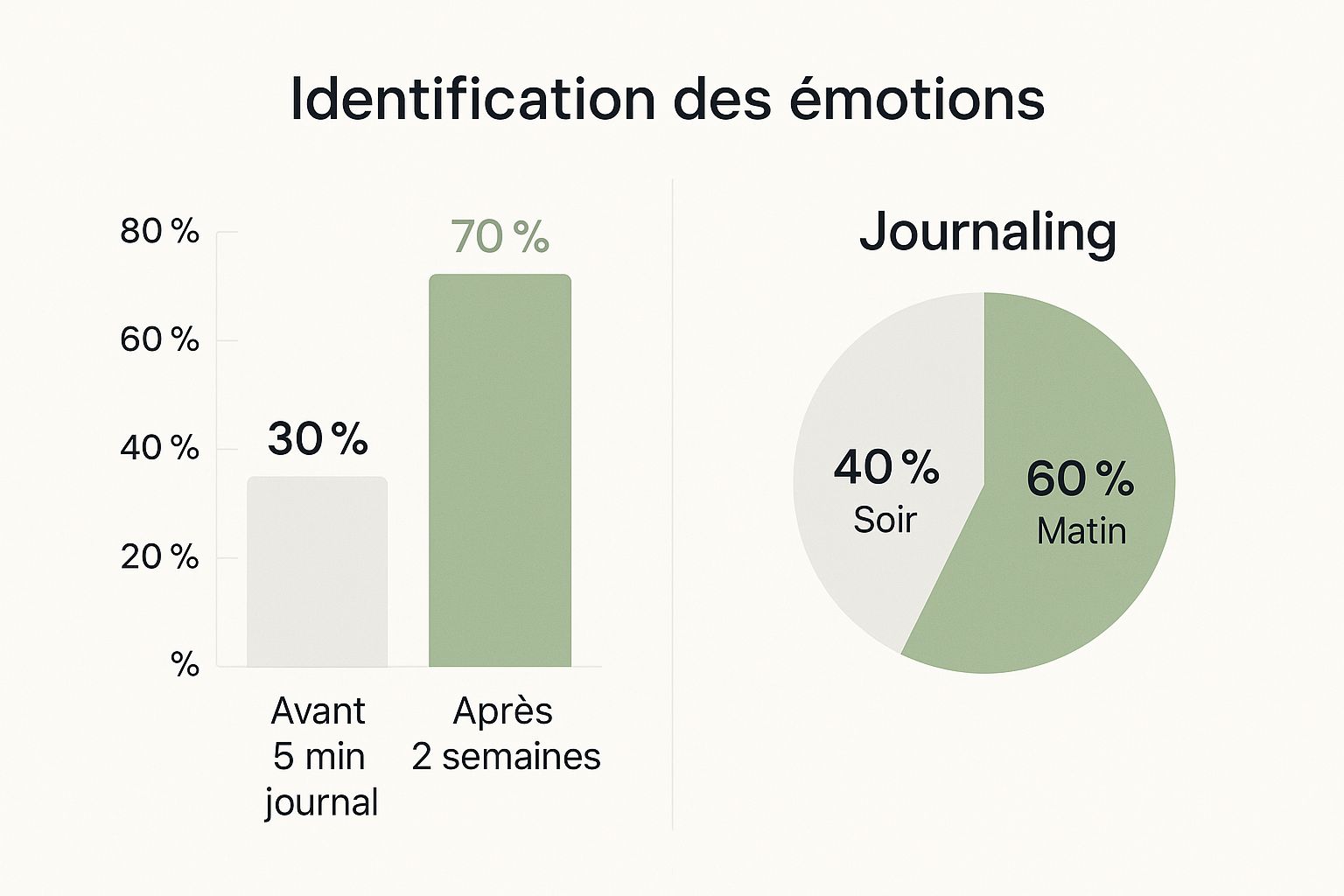
The numbers speak for themselves. After just two weeks, a child's ability to name their feelings can more than double. What was abstract and confusing then becomes much clearer, for them as well as for you.
The 5-minute journal isn't just a notebook. It's a daily workout for the emotional muscle. It teaches your child to look on the bright side, reflect on their day, and become more resilient in the face of challenges, both big and small.
Inspired by positive psychology, the 5-minute journal is a remarkably effective tool. Its quick format is designed to cultivate a positive attitude every day. While very popular with adults, its adaptation for children is a real boost to their personal development. To learn more, you can discover the principles of this tool on World Me Now .
The table below summarizes the key benefits of daily journalism practice for children aged 6 to 12.
The concrete benefits of the 5-minute journal by age
| Key Benefit | Impact on the child (6-8 years old) | Impact on the child (9-12 years old) |
|---|---|---|
| Gratitude | Learn to say "thank you" for the small, simple things (a game, a hug). | Cultivate a deeper appreciation for relationships and experiences. |
| Emotional Management | Start naming the basic emotions (joy, sadness, anger). | Develop strategies to manage more complex emotions such as anxiety. |
| Self-esteem | He feels proud of his small daily successes. | It strengthens one's self-confidence by recognizing one's strengths and progress. |
In summary, whether the child is at the beginning of primary school or on the verge of secondary school, these five minutes provide them with concrete tools to grow up more serenely.
Create a family ritual that your child will love.
To make your 5-minute journal a truly enjoyable experience, the key is to integrate it naturally into your daily routine. The secret? Make it a moment of connection, far removed from homework and academic pressure. The goal isn't to write perfectly, but to share a quality moment together.
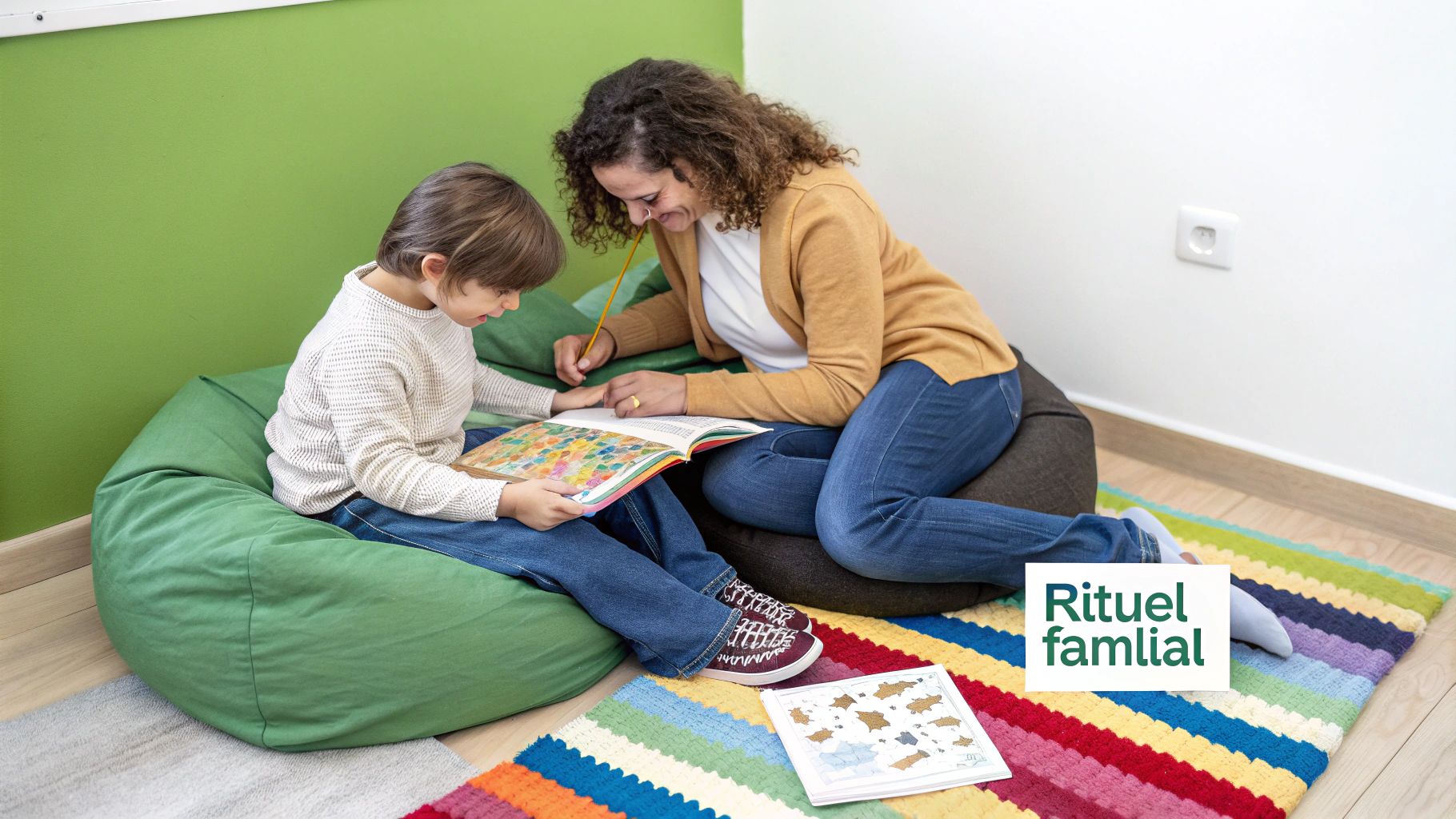
Find the right time, a quiet moment when screens are off and distractions are put aside. The slot right after dinner or before bedtime stories is often ideal. Your child's mind is then calmer and more receptive.
Make it a special moment
Transform these few minutes into a true indoor treasure hunt. No need to go all out; a few small touches are enough to create a magical atmosphere.
- Create a "secret corner": A cozy little nook with cushions, a soft blanket, and dim lighting. This space will quickly become her refuge for writing and drawing.
- Personalize their journal: Let your child make their journal their own. Stickers, glitter, drawings... anything goes! Offer them colored pens and markers to unleash their creativity.
- Present it as a game: Refer to it as her "secret diary" or her "adventure book." These words will stimulate her curiosity and imagination.
The best way to motivate a child is to lead by example. By keeping a journal yourself, you transform what might seem like a chore into a powerful family ritual.
This brief moment then transforms into a precious opportunity to talk about your respective days, without holding back. By sharing your own small victories or things you're grateful for, you show her that talking about your emotions is a strength.
It's a simple way to strengthen your bond while fostering trust and communication. By watching you do it, your child understands that their thoughts and feelings have value. And that's an immense gift.
Supporting his first steps as a writer
Here we go, it's time to get started. For the very first time with this journal, the idea is to create a simple, gentle moment, without any pressure. We're not aiming for perfection, but rather a pleasant experience that will make your child want to do it again tomorrow.

The dreaded writer's block? Forget it. Your role is to be a supportive guide. Ask open-ended questions that spark their curiosity and encourage them to think. It's far more effective than the classic "So, how was your day?", which often ends with a simple "yes".
Questions to start the conversation
To keep this ritual fun, don't hesitate to vary your approach. Suggest exploring their day from a new and enjoyable perspective.
Here are some ideas to break the ice:
-
For younger children (6-8 years old):
- "Tell me the funniest thing that happened to you today!"
- "If your day were an animal, which one would it be? And why?"
- "What if you drew something that made you smile earlier?"
-
For older children (9-12 years old):
- "What's the most interesting thing you learned today?"
- "Was there ever a time when you helped someone? Tell me about it."
- "If you could give your day a superpower, which would you choose?"
The important thing is to show him that anything is possible. A drawing, a few words, a collage with images cut out from a magazine... The essential thing is that he can leave a small trace of what he felt.
Create a bubble of trust, free from judgment.
Your reaction is key. Every time your child shows you a page from their journal, they're opening a little window into their inner world. Welcome what they share with warmth and kindness.
Your child isn't looking for a spell checker, but a confidant. Always value the effort and courage to share, far more than the result. This is how you'll build a safe space where they feel free to be themselves.
Replace judgment with curiosity. Instead of saying "It's well drawn," try saying: "I love the colors you chose! What do they tell me?" or "Thank you so much for sharing this memory with me; it sounds like you had a great time."
This positive approach isn't new, and it has proven its worth. Adopted by many families, the 5-minute journal concept draws on positive psychology to cultivate daily well-being. Its success clearly demonstrates how powerful this simple habit can be for children. You can also learn more about the origins of this simple and effective journaling method .
So that the newspaper truly reflects him
Your child is unique, aren't they? Their 5-minute journal should be too. The key to success is adapting this little ritual to their age and personality. That's how this moment will become a real pleasure and a valuable tool to help them grow.

For a young child, a picture is often worth a thousand words. The idea is to make the experience fun and concrete so that they'll want to get involved.
An approach tailored to each age
For younger children, between 6 and 8 years old , drawing is a natural language. They can therefore be encouraged to use their journal as a sketchbook to express their emotions.
- Think visual: Offer him mood stickers (a smiling face, a crying face, an angry face) that he can stick on to tell about his day. It's simple and super effective.
- Ask specific questions: Instead of a vague "How are you feeling?", try: "If your day was a color, what would it be?" or "Draw what made you super happy earlier."
- Turn it into a game: Why not turn this moment into a guessing game? Try to guess what the drawing is about. Guaranteed laughs!
From the age of 9 , children begin to think more abstractly. A journal can then become a space for further reflection, a first step towards self-knowledge.
The goal isn't to turn your child into a little philosopher, but simply to give them tools to better understand themselves. It's by exploring their own thoughts that they build their confidence.
For 9-12 year olds , you can slip in questions that lead them to reflect on themselves and the world around them.
- "What is the most important thing you learned about yourself today?"
- "Tell us about a time when you felt really brave."
- "If you had to give advice to a friend who is sad, what would you tell them?"
Depending on their temperament: introverted or extroverted?
Also consider your child's personality. If they are more introverted, they will surely love this quiet moment alone with their notebook. It's their private space, so respect their need for privacy.
On the other hand, a more extroverted child might have a blast transforming their 5-minute diary into a comic strip to recount their adventures, or into an explorer's logbook that they'll be so proud to read to you afterward. The important thing is to find the format that resonates with them.
What to do when motivation wanes?
There will inevitably be days when your child exclaims, "Meh, I have nothing to say today." That's perfectly normal. The initial excitement fades, routine sets in, and sometimes, inspiration takes a break.
The biggest mistake you can make? Forcing it. If you sense resistance, insisting will only turn this enjoyable moment into a chore. The goal is to keep this ritual a positive shared experience, not simply a way to check a box. Flexibility is your best friend.
Some tips to get things going again
When the dreaded "I don't know what to write" appears, it's time to put on your creative coaching hat. Here are a few ideas to transform this little block into a new opportunity to have fun together:
- Create themed challenges. Why not imagine a "superpowers week" where he recounts a feat (even a small one) each day? Or a "brilliant inventions week" to let his imagination run wild?
- Change the rules of the game. Who said writing is mandatory? Suggest they record their thoughts of the day on a phone, like a secret podcast. It's fun and it changes everything!
- Press "pause." Sometimes, the best thing to do is nothing. Allow yourself to skip a day or two. Very often, the urge to pick up your pen again will return on its own.
The 5-minute journal should first and foremost remain a space for freedom. When the mood isn't there, a great alternative is to reread the pages from previous weeks together. Celebrating the journey so far and reliving good memories is often the best way to rekindle the flame.
This need to structure positive thinking is precisely what explains the success of tools like the "Five Minute Journal" app. Its popularity clearly demonstrates that the idea of a daily gratitude journal resonates with many people. You can learn more about how the Five Minute Journal app works and its success , and find some ideas to enrich your own family ritual.
Your questions (and our answers) about the 5-minute news report
Embarking on the adventure of creative journaling with your child is fantastic! But it's perfectly normal to have a few questions before starting. After all, we want it to be an enjoyable and truly beneficial experience for them. So, let's answer the most frequently asked questions from parents.
Is my child old enough to start?
That's an excellent question. Generally, it's recommended to start around age 6. Why? Because it's often around this age that children begin to put words to their feelings. A journal then becomes a fantastic tool to support them in this process, especially with drawing!
Obviously, a 12-year-old won't use their notebook the same way a 7-year-old does. One might write long texts, while the other might prefer to draw or even make collages. The most important thing is to adapt to them and encourage them to express themselves however they feel comfortable.
And what about the confidentiality of his diary?
The diary is his little secret garden, his own private space. For him to dare to confide his joys, his sorrows, and his wildest dreams, he must feel completely safe. No one should snoop around without his permission.
The golden rule, to be established from day one: his journal is private. You will only read it if he invites you to. It's a pact of trust between you, and it's this respect that will strengthen your bond.
This trust is key to him truly making this journal his own. And if he decides to share a page with you, savor the moment. It's a real gift, a door he's opening to his inner world. Welcome his confidences with kindness, without judgment. It's in these moments of sharing that the magic happens.
The My Book Story journal was designed precisely for this purpose: to offer a supportive environment to guide your child on this wonderful adventure. It's the perfect companion to help them grow in confidence.